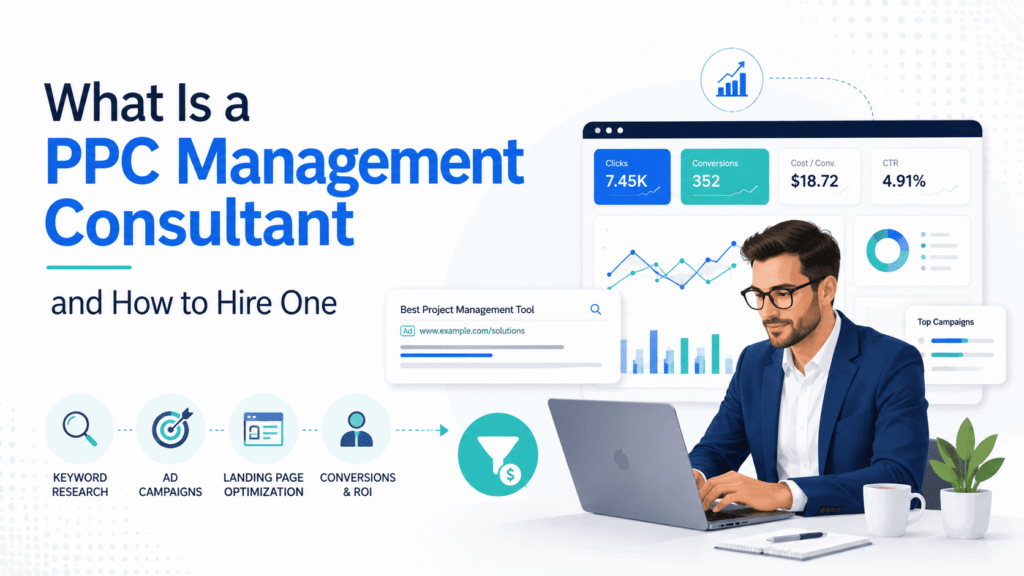
A PPC management consultant is a paid advertising specialist who helps businesses plan, manage, track, and optimize pay-per-click campaigns. Their main role is to improve keyword targeting, ad copy, bidding, landing pages, conversion tracking, and performance reporting so the business can reduce wasted ad spend and generate better leads, calls, bookings, or sales. Instead of focusing only on clicks, a professional PPC consultant considers the full journey from search intent to final conversion and helps businesses make smarter decisions with their advertising budget.
For many businesses, pay-per-click advertising can seem simple at first. They create a Google Ads account, choose a few keywords, write ads, set a daily budget, and wait for results. However, profitable PPC campaign management requires much more than launching ads. It needs proper research, campaign structure, testing, tracking, reporting, and continuous optimization. This is where a PPC management consultant becomes valuable.
A skilled paid search consultant helps businesses reduce wasted spend, improve ad relevance, attract better traffic, and measure real outcomes. Their role is not only technical. It also includes strategy, communication, analysis, and understanding how customers make decisions online.
What Is a PPC Management Consultant?
A PPC management consultant is an expert who manages and improves paid advertising campaigns for businesses. PPC stands for pay-per-click, meaning the advertiser pays when someone clicks an ad. These ads may appear on Google Search, Microsoft Ads, YouTube, display networks, shopping results, or other paid advertising platforms.
The consultant’s job is to make sure that the business is not only getting traffic but also getting the right traffic. A campaign may bring hundreds of clicks, but if those clicks do not turn into calls, leads, purchases, bookings, or quote requests, the campaign is not performing properly.
A PPC consultant studies the business goals, target audience, keyword intent, competition, budget, landing page quality, and conversion data. After reviewing these areas, the consultant builds or improves a PPC strategy that is focused on measurable results.
What Does a PPC Management Consultant Do?
A PPC management consultant handles the planning, setup, monitoring, and optimization of paid campaigns. Their daily work often includes reviewing search terms, adjusting bids, testing ad copy, improving landing page alignment, checking conversion data, and preparing performance reports.
Their role is different from simply “running ads.” A consultant looks more deeply into why a campaign is working or wasting money. For example, if a business is receiving many clicks but very few leads, the issue may be poor keyword selection, weak ad copy, low landing page trust, missing conversion tracking, or targeting the wrong audience.
Key Responsibilities of a PPC Consultant
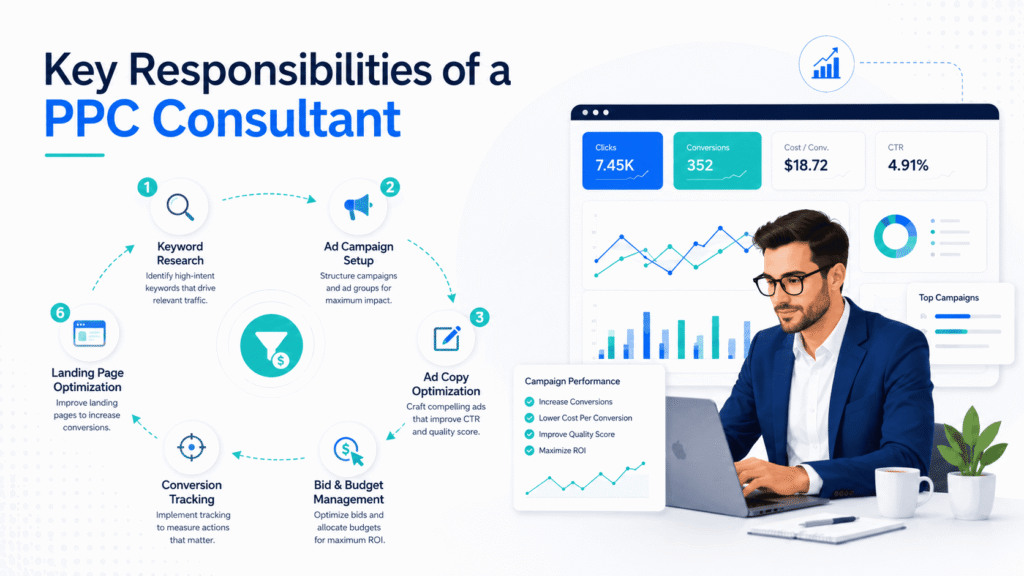
A PPC consultant may handle different tasks depending on the business’s size and campaign goals. However, most PPC management services include several important responsibilities.
Keyword Research and Search Intent Analysis
Keyword research is the foundation of PPC campaign management. A consultant identifies which search terms are likely to bring valuable traffic and which terms may waste budget.
Not every keyword has the same intent. A person searching “what is PPC advertising” may only want information, while someone searching “hire PPC management consultant” may be closer to making a business decision. A PPC expert understands this difference and groups keywords according to intent.
They also add negative keywords to stop ads from showing for irrelevant searches. This helps reduce wasted clicks and improves campaign quality.
Campaign Structure and Ad Group Planning
A well-structured PPC account is easier to manage, measure, and optimize. A PPC management consultant organizes campaigns by service, product, location, audience, or search intent.
For example, a business offering multiple services should not place all keywords in a single ad group. Each service should have its own campaign or ad group with relevant keywords, ad copy, and landing pages. This improves ad relevance and gives clearer performance data.
Poor campaign structure can lead to budget waste because unrelated keywords and ads compete inside the same account. A consultant creates a clean structure, so each campaign has a clear goal.
Ad Copy Optimization
Ad copy is one of the most important parts of paid advertising. A PPC consultant writes and tests headlines, descriptions, offers, and calls to action. The goal is not only to increase the click-through rate but to attract users who are more likely to convert.
Strong PPC ad copy usually includes the main service, benefit, location, trust signal, and clear next step. For example, a local service business may use ad messaging around fast response, free quotes, certified work, or same-day availability.
A consultant may test different versions of ads to see which message produces better results. This testing helps improve performance over time.
Bid and Budget Management
Budget control is one of the main reasons businesses hire a PPC consultant. Without proper bid management, campaigns can spend money quickly without delivering enough leads or sales.
A consultant reviews cost per click, cost per conversion, daily budget, device performance, location performance, and campaign timing. They may increase the budget for profitable campaigns and reduce spend on keywords or audiences that are not converting.
The goal is to use the budget where it has the highest chance of producing a return.
Conversion Tracking and Measurement
Accurate conversion tracking is essential for PPC success. A campaign cannot be properly optimized if the business does not know which clicks are turning into real actions.
A PPC management consultant may help track form submissions, phone calls, purchases, bookings, quote requests, downloads, or sign-ups. Tools such as Google Analytics 4, Google Tag Manager, and platform conversion tracking are often used to measure these actions.
Without tracking, a business may only see clicks and impressions. That does not show whether the campaign is actually profitable. Proper tracking helps the consultant make better decisions based on real performance.
Landing Page Review and Optimization
A PPC campaign does not end after the click. The landing page must convince the visitor to take action. If the page is slow, confusing, poorly written, or not relevant to the ad, users may leave without converting.
A PPC consultant reviews landing pages for message match, speed, mobile experience, trust signals, form placement, call-to-action visibility, and content clarity. Even small landing page improvements can make a major difference in campaign results.
For example, if the ad promotes “free consultation,” the landing page should clearly show the same offer. This creates a smoother experience for the visitor and improves the chance of conversion.
Skills Required for PPC Management
A professional PPC consultant needs a mix of analytical, technical, and creative skills. They should understand how advertising platforms work, how users search, and how businesses turn visitors into customers.
Important PPC management skills include keyword research, campaign setup, bidding strategy, ad copywriting, conversion tracking, landing page analysis, reporting, and competitor research.
A consultant should also be able to explain campaign results in simple language. Business owners do not only need complex charts. They need to understand what changed, why performance changed, and what steps should be taken next.
PPC Consultant vs PPC Agency
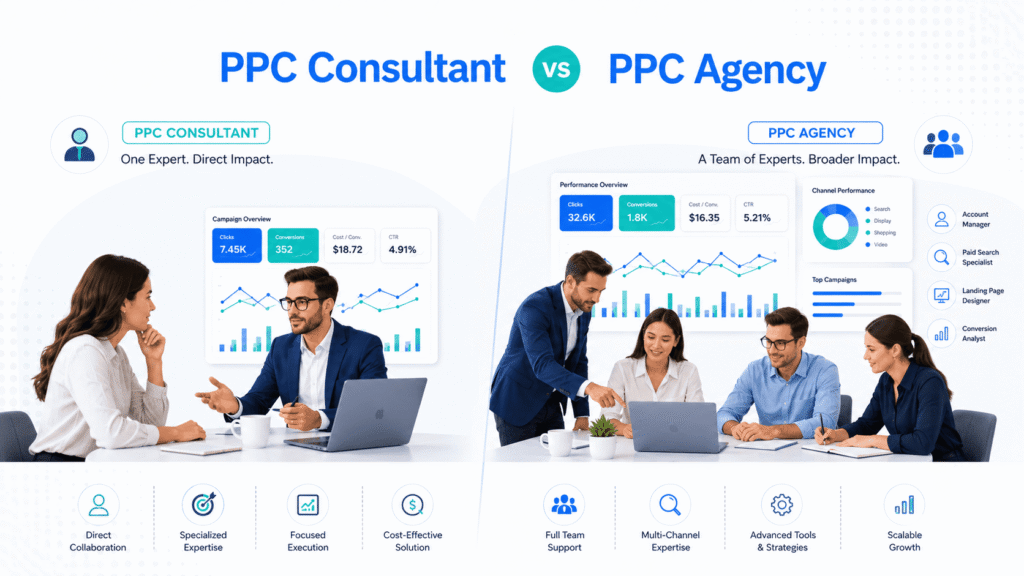
A PPC consultant and a PPC agency can both help with paid advertising, but their approaches, costs, and levels of support may differ. A PPC consultant usually provides direct expert guidance, audits, strategy, and campaign optimization. This can be useful for businesses that already have an internal marketing person but need specialist paid ads support.
A PPC agency may provide a larger team that handles campaign management, design, copywriting, tracking, and reporting under one service. This may be better for businesses that want complete PPC management services and do not have an internal marketing team.
| Factor | PPC Consultant | PPC Agency |
| Best For | Strategy, audits, expert guidance, and optimization | Full campaign execution and ongoing management |
| Team Size | Usually one expert or a small specialist team | Larger team with multiple roles |
| Communication | More direct communication with the expert | Often through an account manager |
| Cost | Often more flexible for small businesses | Usually higher monthly management cost |
| Support Level | Focused support for PPC strategy and performance | Broader support including creative, reporting, and tracking |
| Good Choice For | Small businesses, startups, or internal marketing teams | Growing businesses that need full-service PPC management |
The right choice depends on the business goal, budget, and internal resources. A small business may prefer a consultant for focused guidance and cost control, while a growing company may choose an agency for full execution and wider marketing support.
When Should a Business Hire a PPC Management Consultant?
A business should consider hiring a PPC management consultant when paid ads are running but results are unclear, expensive, or inconsistent.
Common signs include campaigns getting clicks but no leads, high cost per conversion, poor keyword performance, missing tracking, weak landing pages, irrelevant search terms, and unclear reporting.
A consultant can also help before launching a new campaign. Starting with proper structure, tracking, and keyword planning can prevent unnecessary budget waste from the beginning.
Businesses that depend on leads, calls, bookings, or online sales can benefit from expert PPC guidance because every wasted click affects profit.
PPC Management Process: How Consultants Improve Campaigns
A professional PPC consultant usually follows a clear process instead of making random changes. The process often starts with account auditing, keyword research, campaign restructuring, conversion-tracking setup, ad testing, bid optimization, landing-page review, and monthly reporting.
This structured approach helps businesses understand where their budget is going and what improvements are being made. It also makes PPC performance easier to measure because every change is connected to a specific goal, such as lower cost per lead, better conversion rate, or higher return on ad spend.
A consultant may first review the existing account to find wasted spend, weak keywords, poor ad groups, missing negative keywords, or tracking errors. After that, they create a plan to improve campaign structure and performance. Over time, they use data to make better decisions and continue improving the campaign.
Important PPC Metrics a Consultant Tracks
A PPC consultant does not judge success only by clicks. Clicks are important, but they do not always mean the campaign is profitable. A campaign can receive many clicks and still fail if users do not convert.
Important PPC metrics include click-through rate, cost per click, conversion rate, cost per conversion, impression share, Quality Score, return on ad spend, and lead quality.
These metrics help show whether the campaign is only generating traffic or actually producing business results. For example, a lower cost per click may look good, but if those clicks do not bring leads, they may not be valuable. A consultant looks at the full performance picture before making decisions.
How PPC Consultants Improve ROI
The main goal of a PPC consultant is to improve return on ad spend. This means helping the business get more value from the same or better-controlled advertising budget.
A consultant improves ROI by removing wasted keywords, improving ad relevance, testing better ad copy, adjusting bids, improving conversion tracking, and reviewing landing pages. They also identify which campaigns deserve more budget and which campaigns should be paused or rebuilt.
For example, one campaign may have a high click-through rate but poor conversions. Another campaign may have fewer clicks but a lower cost per lead. A PPC expert looks beyond surface-level numbers and focuses on meaningful business results.
What Makes a PPC Consultant Trustworthy?
A trustworthy PPC consultant is transparent, data-driven, and realistic. They do not promise instant success or guaranteed sales because PPC performance depends on competition, budget, offer quality, landing page experience, and market demand.
A reliable consultant explains what is being changed, why it matters, and how it affects campaign performance. They provide clear reports, honest recommendations, and practical next steps.
Trust also comes from experience. A strong PPC consultant understands that paid advertising is connected to the full business process, not only the ad account. The campaign, website, offer, tracking, and sales process must all support each other.
Is a PPC Management Consultant Worth It?
A PPC management consultant can be worth it for businesses that want better control over paid advertising performance. Instead of guessing which keywords, ads, or budgets will work, the business gets a structured strategy based on data, testing, and experience.
The right consultant like Camziotech helps reduce wasted spend, improve campaign quality, strengthen tracking, and connect paid traffic with real business goals. For companies that depend on leads, calls, bookings, or online sales, professional PPC campaign management can turn paid advertising into a more reliable growth channel.
FAQ’s
What is a PPC management consultant?
A PPC management consultant is a paid advertising expert who helps businesses plan, manage, and improve pay-per-click campaigns. Their work includes keyword research, ad copy, bidding, tracking, landing page review, and performance reporting.
Is PPC management only for Google Ads?
No. PPC management can include Google Ads, Microsoft Ads, YouTube ads, display campaigns, shopping ads, remarketing, and paid social advertising. Google Ads is one of the most common platforms, but it is not the only option.
How does a PPC consultant reduce wasted ad spend?
A PPC consultant reduces wasted spend by improving keyword targeting, adding negative keywords, adjusting bids, removing weak campaigns, improving ad copy, and focusing budget on areas that generate conversions.
Does a PPC consultant improve landing pages?
Many PPC consultants review landing pages because landing page quality affects campaign results. They may suggest clearer headlines, stronger calls to action, better forms, faster loading speed, and improved trust signals.
How long does PPC optimization take?
Some improvements can be made quickly, such as fixing tracking or removing irrelevant keywords. However, deeper PPC optimization usually takes time because the consultant needs enough data to test and improve campaign performance.