

The internet now feels almost immediate. Pages render in moments, videos begin playing with little delay, and browser-based tools often feel as responsive as installed software. That experience did not happen by accident. It came from years of engineering improvements, infrastructure upgrades, and smarter development practices that gradually removed friction from the web. The most important tech ideas that made the web move faster were not just about raw speed. They were about reducing latency, cutting unnecessary transfers, improving efficiency, and making websites feel smooth in real-world conditions.
In the early days of the web, speed was limited by slow connections, simple protocols, and simple basic websites. As the internet expanded into business, ecommerce, entertainment, and cloud-based software, performance stopped being a technical luxury and became a user expectation. Today, where fast web performance affects engagement, retention, and overall user experience. That is why modern web development pays close attention to website speed optimization, page load time, and device responsiveness.
Why the Web Needed to Become Faster
The web became more demanding as websites moved from simple pages to media-rich experiences and interactive applications. A single page could include HTML, stylesheets, JavaScript, images, fonts, analytics tools, and API requests. Without better systems, every extra asset added to the delay. From the search, many of the biggest web performance innovations were created to solve that exact problem: how to deliver more content with less waiting.
This shift also changed how performance was understood. Speed was no longer only about whether a page eventually loaded. It became about whether meaningful content appeared quickly, whether the page responded promptly to user input, and whether the experience stayed stable while loading. That broader view of performance helped shape the modern internet.
Smarter HTTP Protocols Changed Web Communication
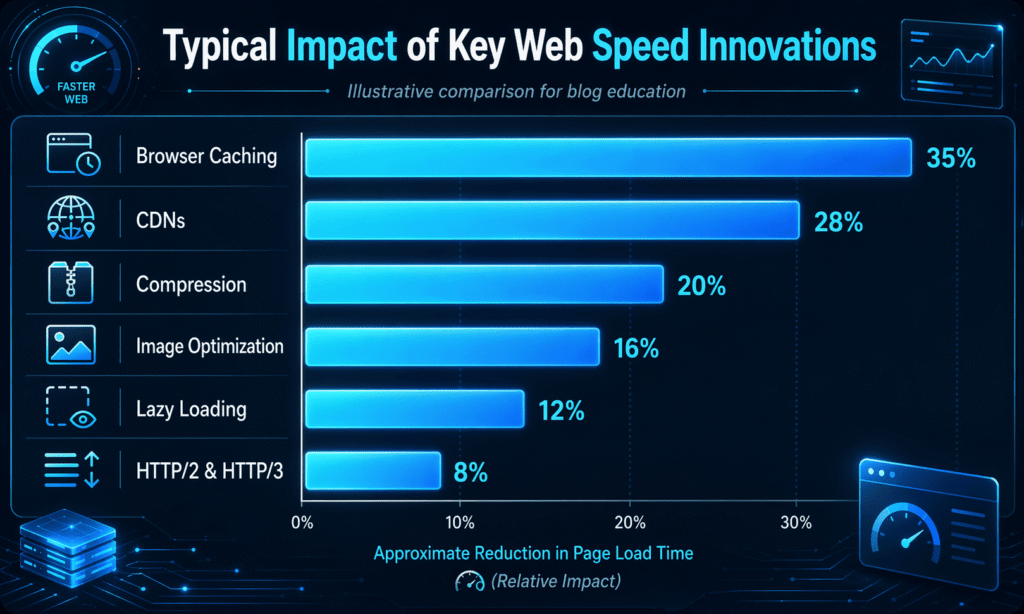
One of the most important technological advances that made the web run faster was the evolution of HTTP. HTTP is the foundation of how browsers request and receive web resources. Earlier versions worked well enough for basic pages, but they were not efficient for the modern web. As websites became more complex, those limitations became harder to ignore.
HTTP/2 introduced major improvements that helped websites load faster. It allowed multiple requests to move through a single connection more efficiently and reduced overhead through better header handling. In simple terms, it helped browsers fetch many resources without getting slowed down by older communication patterns. That made a noticeable difference for pages filled with scripts, images, and stylesheets.
HTTP/3 pushed performance further by improving connection handling and reducing delays, especially on weaker or unstable networks. This matters because even small improvements in how data is requested and delivered can make browsing feel faster in everyday use. Together, these protocol upgrades played a major role in improving website speed and modern web performance.
CDNs and Edge Delivery Brought Content Closer
Another breakthrough among the tech ideas that accelerated the web was the rise of content delivery networks. A CDN stores and serves cached assets from servers located closer to users. Instead of forcing every request to travel back to a distant origin server, a CDN shortens the journey and reduces latency.
This idea sounds simple, but its effect is powerful. When assets such as images, JavaScript files, stylesheets, and videos are served from nearby locations, the web feels faster even if the original website is hosted far away. CDNs also reduce strain on the main server, which improves reliability during traffic spikes.
Edge delivery expanded this idea further by moving some processing closer to the user as well. Instead of caching content alone, edge systems can handle certain requests near the visitor’s location. That reduces round-trip times and improves responsiveness, especially for modern applications that depend on speed and real-time interaction.
Compression: Cut the Weight of the Web
Many websites became faster not because networks became infinitely more powerful, but because files became smaller. Compression remains one of the most practical website speed optimization techniques. Smaller files move faster across networks and reduce the time needed to make a page usable.
This became even more important as websites became more visual. Images, fonts, videos, and scripts can quickly become heavy enough to slow down rendering. Using efficient image formats and compressed text-based resources reduces the amount of data that must be downloaded before a page becomes useful. The same logic applies to video and media delivery, where smarter encoding helps preserve quality while lowering file size.
Compression also improves performance on average mobile connections. A site that feels fine on fast office internet can feel frustrating on normal mobile data if it sends bloated assets. That is why compression is not just a technical improvement. It is also an improvement in usability and accessibility.
Caching Prevented Repeated Work
Browser caching is one of the quieter tech ideas that made the web move more quickly, but it has had a lasting impact. Instead of downloading the same resources every time a user re-visits website, the browser can store assets locally and reuse them. This speeds up return visits and reduces unnecessary server requests.
Caching also works at different levels. Browsers can cache files on the user’s device, while CDNs can cache them near the user. Together, these layers reduce repeated work across the web. When caching rules are set correctly, websites load faster with no visible design changes. That makes caching one of the highest-value web performance practices still used today.
Better Browsers Made Websites Feel More Powerful
The web did not become faster solely through servers. Browsers themselves became much better at processing code, rendering layouts, and handling complex interactions. Modern browsers have improved how JavaScript is executed and how visual changes are painted to the screen, helping the web move closer to app-like responsiveness.
This change also made richer experiences possible. Interactive dashboards, editors, e-commerce filters, and live interfaces became more practical as browsers could handle more work more efficiently. In that sense, browser innovation not only made websites faster. It expanded the possibilities of the web.
Smarter Loading Strategies Improved Perceived Speed
Not every performance improvement came from faster hardware or better protocols. Some of the best ideas came from deciding what should load first and what could wait. Modern performance practices focus on reducing render-blocking resources, delaying non-critical scripts, optimizing HTML delivery, and loading media more intelligently. These strategies help users see useful content sooner, even before all background assets finish loading.
This is where lazy loading, script deferral, code splitting, and preloading became valuable. Even when a page contains many resources, it does not need every one of them immediately. By prioritizing above-the-fold content and delaying lower-priority assets, developers improve perceived performance and actual load time. That reflects an important truth about web speed: users respond to experience, not just raw technical numbers.
Core Web Vitals Turned Speed Into a Measurable Standard
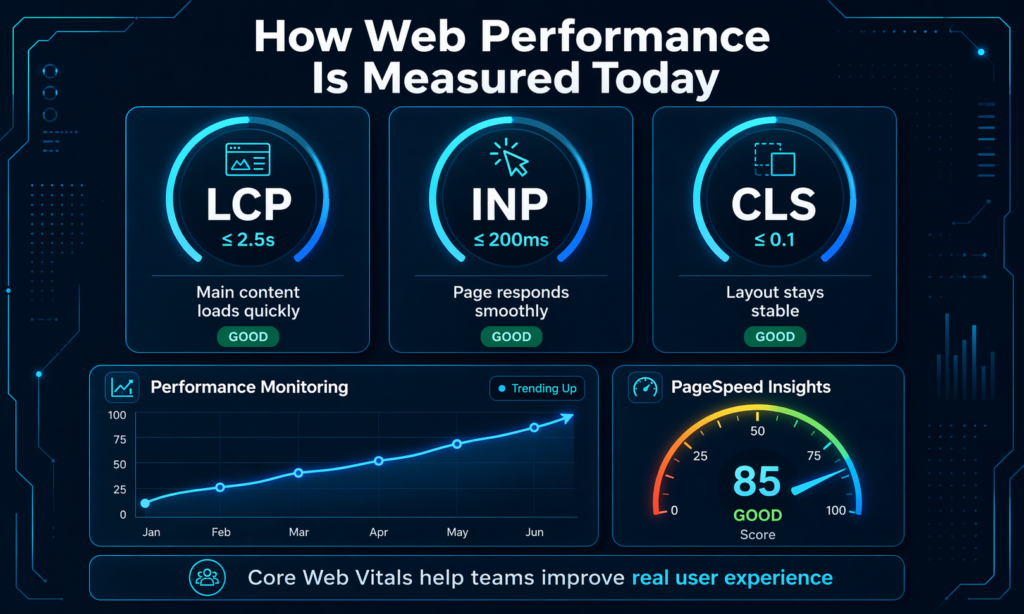
Today, web performance is not judged only by whether a page eventually loads. It is also measured by how quickly the main content appears, how stable the layout remains, and how responsive the page feels when a visitor interacts with it. That is why Core Web Vitals have become such an important part of modern performance thinking. They give site owners a clearer framework for improving real user experience rather than only chasing raw speed metrics.
This measurement culture matters because it changes how teams improve websites. Once performance can be tracked consistently, it becomes easier to identify bottlenecks, prioritize fixes, and focus on changes that make the biggest difference. Instead of making random adjustments, developers can work toward meaningful improvements in page speed, interaction, and visual stability.
Tools such as PageSpeed Insights have made this process more accessible. In practical SEO and web performance work, measurement is now part of the workflow rather than an afterthought. That shift helped shift web optimization from guesswork to a more reliable, user-focused discipline.
Why These Innovations Still Matter
The technologies that improved website speed did more than reduce waiting time. They changed user expectations. Faster resource delivery made ecommerce smoother, media streaming more reliable, remote tools more usable, and mobile browsing more tolerable across different connection types. In business terms, quicker websites often support stronger engagement and a better overall customer experience.
They also changed how developers build. Modern web teams now think in terms of performance budgets, asset prioritization, efficient delivery, responsive interaction, and real-user experience. The web became faster not because of a single invention, but because many systems started working together: protocols, browsers, servers, CDNs, compression, caching, and better development discipline.
For site owners and publishers, these innovations are not just part of internet history. They continue to shape how websites are built, tested, and improved today. A fast site now depends on efficient delivery, lighter assets, responsive interaction, and continuous testing through tools such as PageSpeed Insights. In other words, the same ideas that made the web faster in the past still guide website optimization today.
Conclusion
The web’s speed revolution was built step by step. Smarter HTTP versions reduced connection inefficiencies. CDNs and edge delivery brought content physically closer to users. Compression reduced file weight. Caching avoided repeated downloads. Better browsers handled code and rendering more efficiently. Performance measurement frameworks gave teams a clearer way to improve what users actually feel. Together, these were the tech ideas that made the web move quicker and transformed the internet from a slow document network into a responsive digital platform.
For modern businesses, publishers, and developers, the lesson is clear: speed is never about one single trick. It comes from combining strong infrastructure, efficient delivery, clean development practices, and ongoing measurement. That is why web performance optimization remains one of the most important parts of building a better digital experience today.
FAQ’s
What are the tech ideas that made the web move more quickly?
The biggest advances include HTTP/2 and HTTP/3, content delivery networks, compression, browser caching, smarter loading strategies, and better performance measurement. Together, these improvements reduced latency, improved page speed, and helped websites deliver content more efficiently.
Will a CDN always make a website faster?
Not always, but a CDN often improves speed by serving files from servers closer to the visitor. In Reddit discussions, this question came up most often for image-heavy or multi-region websites, where reducing physical distance between the user and the content can noticeably improve load time.
How did HTTP/2 and HTTP/3 improve web performance?
HTTP/2 improved efficiency by allowing multiple resources to be transferred over a single connection, while HTTP/3 improved connection speed and reliability. Both helped reduce delays and made modern websites feel faster.
Does faster internet alone make websites load quickly?
Not always. Bandwidth matters, but caching, file size, protocol efficiency, browser rendering, and overall website architecture also affect how quickly a page feels to real users.
How is web performance measured today?
Modern web performance is measured through a mix of loading speed, responsiveness, and visual stability. A widely used framework is Core Web Vitals, which focuses on how quickly key content appears, how stable the layout remains, and how responsive the page feels during interaction.
Why are some websites still slow even with modern technology?
A website can still feel slow for many reasons, including unoptimized code, weak caching or serving strategy, poor hosting, too many heavy assets, third-party requests, or user-side limitations such as device and browser performance.