

Claude is increasingly used to research products, compare companies, evaluate software, understand technical subjects, and find reliable recommendations. This shift has created a new visibility challenge for brands: a website may perform well in traditional search results but remain absent from Claude-generated answers.
Claude AI search visibility depends on how easily the platform can find, understand, verify, and use information from a webpage. The most important Claude AI search visibility factors include prompt relevance, clear answer formatting, credible authorship, supporting evidence, topical depth, original information, content freshness, consistent brand entities, independent mentions, and technical accessibility. Anthropic has not published an official ranking formula, but accurate, well-supported, and easily extractable content gives Claude stronger material to mention and cite.
What Are Claude AI Search Visibility Factors?
Claude AI search visibility factors are the content, authority, relevance, and technical signals that may influence whether a website appears in a Claude response.
A business can receive visibility in several ways:
- Mention: Claude names the brand, publication, product, or expert.
- Citation: Claude links to a webpage as supporting evidence.
- Recommendation: Claude presents a company or product as a suitable option.
- Source inclusion: Information from a page contributes to the generated answer.
Claude visibility is different from holding a fixed ranking position in Google. Results can change according to the prompt wording, required level of detail, user context, topic freshness, and available evidence.
For this reason, Claude search optimization should focus on building useful and trustworthy information rather than chasing a single keyword position.
How Claude Finds Useful Information
When a question requires current or specialized information, Claude can search the web, examine relevant pages, and use supporting sources to prepare an answer.
A page does not become useful simply because it contains the right keyword. Claude must be able to identify a relevant passage, understand what it means, evaluate whether it is credible, and connect it to the user’s question.
Pages are more suitable for AI retrieval when they contain:
- Clearly labelled sections
- Direct answers
- Consistent brand and author details
- Verifiable facts
- Relevant examples
- Logical internal links
- Accessible page content
- Updated information
The following Claude AI search visibility factors address each of these requirements.
1. Prompt-to-Answer Alignment
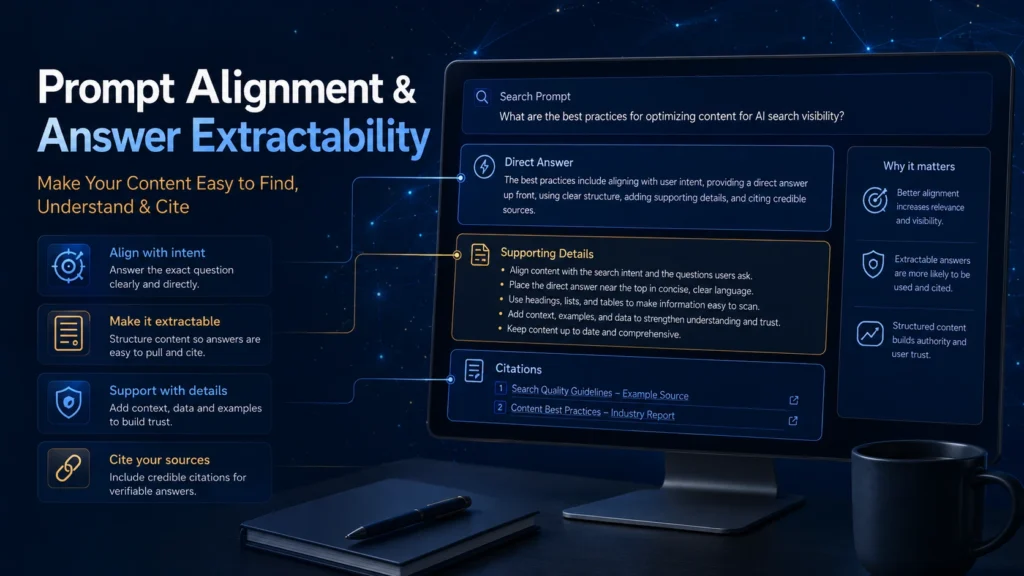
Prompt alignment measures how closely a page answers the complete question behind a Claude search.
Traditional keyword research often focuses on short phrases. Claude users, however, tend to ask longer and more specific questions.
A person may not ask only for “best CRM software.” The actual prompt may be:
Which CRM is suitable for a 50-person B2B company that needs email automation, Salesforce integration, and simple reporting?
A generic CRM article may not satisfy that request. A stronger page would discuss team size, integrations, reporting requirements, implementation difficulty, pricing, limitations, and ideal use cases.
To improve Claude search visibility, publishers should build content around real problems and decision-making scenarios. The page should answer not only what something is, but also who it is suitable for, when it should be used, and what limitations should be considered.
2. Answer Extractability
Answer extractability refers to how easily Claude can identify a clear passage and use it in a response.
A strong section normally follows a simple structure:
- A descriptive heading
- A direct opening answer
- Supporting context
- Evidence or an example
- A practical conclusion
For example, a heading such as “Does Schema Markup Improve Claude Visibility?” is more useful than “Other Considerations.”
The first sentence below the heading should answer the question immediately. The remaining paragraph can explain conditions, limitations, and related details.
Definitions, short summaries, comparison tables, numbered steps, and concise findings all make content easier to extract. Long introductions and vague marketing language make useful information harder to locate.
3. Source Credibility
Claude needs reliable material when generating factual answers. Content supported by visible expertise and credible evidence is more useful than anonymous or unsupported copy.
Strong credibility signals include:
- A named author
- Relevant professional experience
- A detailed author profile
- An expert reviewer
- A visible publication date
- A meaningful update date
- Supporting sources
- Original examples
- Clear research methods
- Honest limitations
A page does not become authoritative by repeatedly claiming to be “the best” or “industry-leading.” Such claims require evidence.
A detailed article written by a recognized specialist, supported by practical examples and reviewed for accuracy, creates a stronger trust foundation than generic content published without an author or methodology.
4. Entity Clarity and Brand Consistency
Claude must be able to understand what a business is, which services it provides, and how it relates to a specific industry.
Entity clarity becomes stronger when the same essential information appears consistently across the website and external profiles.
This includes:
- Official brand name
- Product or service category
- Business location
- Founder or leadership details
- Areas of expertise
- Contact information
- Author identities
- Social profiles
- Partner relationships
Conflicting descriptions can create uncertainty. A company described as an SEO agency on its homepage, a software provider on another profile, and a general consultancy elsewhere may be difficult to classify.
Clear About, Service, Product, Author, Contact, and Case Study pages help establish the relationship between the company, its people, its expertise, and the problems it solves.
5. Third-Party Validation
A company’s website is only one part of its online evidence.
Claude may use independent sources to verify whether a brand, expert, product, or claim is recognized outside the company’s own domain. Relevant third-party references can therefore strengthen Claude AI visibility.
Useful validation may come from:
- Industry publications
- Professional associations
- Partner websites
- Trusted directories
- Independent reviews
- Customer case studies
- Research reports
- Conference profiles
- Expert interviews
This does not mean that businesses should create hundreds of low-quality listings. Relevance, context, and credibility are more valuable than mention volume.
A brand that is consistently described across its website, partner pages, review platforms, and industry publications is easier to verify and understand.
6. Semantic Depth and Topical Completeness
Semantic optimization means covering the complete subject rather than repeating one exact keyword.
An article about Claude AI search visibility factors should naturally explain connected topics such as:
- Claude citations
- Claude search optimization
- Prompt relevance
- Source credibility
- Entity recognition
- Answer extractability
- Topical authority
- Original information
- Content freshness
- Technical crawlability
- Structured data
- AI visibility measurement
These terms should appear because they are necessary to explain the topic, not because they have been inserted to increase keyword density.
A complete page answers the reader’s next logical questions. It explains definitions, practical applications, limitations, examples, mistakes, and measurement methods. Topical depth is not determined by word count alone. A 1,200-word article that covers the full search intent can be more useful than a 3,000-word article filled with repeated general advice.
7. Original Information Gain
Claude has little reason to prefer a page that repeats the same points already available across many competing websites.
Information gain is the additional value a page contributes beyond existing content.
Original value may come from:
- Firsthand testing
- Internal research
- Industry surveys
- Anonymized customer data
- Expert interviews
- Case studies
- Proprietary frameworks
- Before-and-after results
- Implementation lessons
For example, a marketing agency could test a group of commercial prompts in Claude and record which types of pages receive citations. A report explaining the methodology, results, patterns, and limitations would provide stronger information gain than a generic article stating that “quality content matters.”
Original information must be clearly labelled and easy to understand. Data without context or methodology can weaken trust rather than strengthen it.
8. Content Freshness
Freshness becomes important when a prompt relates to changing information, such as product features, software pricing, regulations, statistics, or market trends.
A meaningful content update may include:
- Rechecking factual claims
- Replacing outdated examples
- Adding recent developments
- Updating screenshots
- Revising recommendations
- Removing discontinued products
- Correcting old statistics
- Explaining what has changed
Changing the displayed date without improving the content does not create genuine freshness.
Evergreen definitions may not require frequent changes, but comparison pages, product guides, technology articles, and market reports should be reviewed regularly. A visible and accurate update date also helps readers understand whether the page reflects current conditions.
9. Technical Accessibility
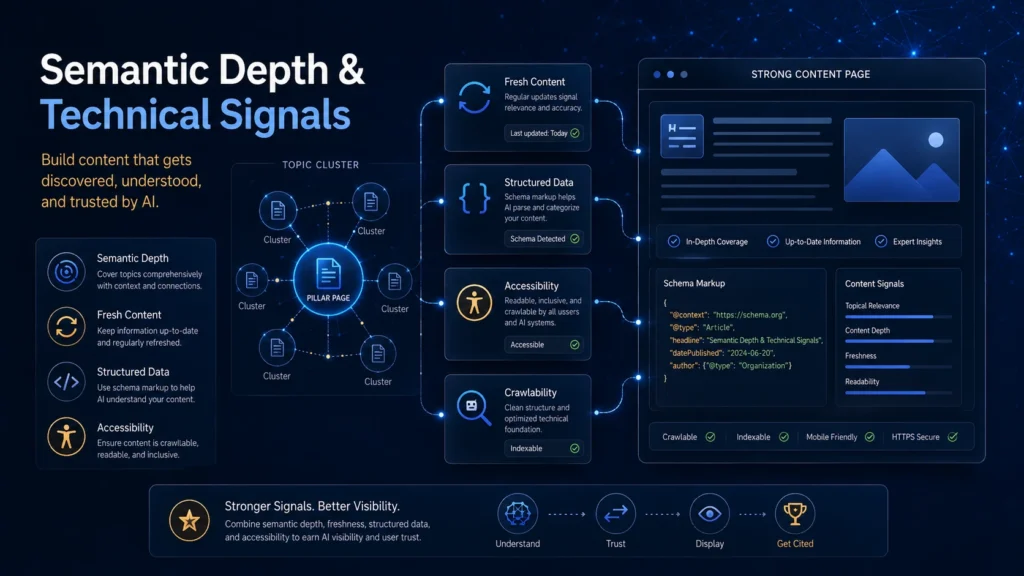
Claude cannot use content that is inaccessible or difficult to retrieve.
Important information should not be unnecessarily hidden behind:
- Login screens
- Lead-generation forms
- Broken JavaScript
- Server errors
- Incorrect noindex tags
- Restrictive robots settings
- Uncrawlable navigation
- Gated documents
- Slow or unstable pages
Core information should be available in readable webpage content. Supporting pages should be connected through standard internal links, and important articles should not be left orphaned.
Technical accessibility does not create authority by itself, but it allows high-quality content to be discovered and processed. A well-written page that cannot be accessed has little opportunity to earn a Claude citation.
10. Structured Page Context
Structured data and clear page organization can help machines interpret a webpage.
Relevant schema types may include:
- Article
- Organization
- Person
- Product
- Service
- LocalBusiness
- BreadcrumbList
- FAQPage, when appropriate
There is no public confirmation that schema markup directly improves Claude rankings. Its value lies in reinforcing context.
Accurate structured data can clarify:
- Who wrote the article
- Which organization published it
- When it was published
- When it was updated
- Which product or service is discussed
- How the page relates to the wider website
Schema should match the visible page content. It should support clear information rather than attempt to compensate for weak writing or unsupported claims.
How to Measure Claude AI Search Visibility
Claude visibility should be measured across a planned group of prompts rather than through one isolated search.
Businesses can track:
- Whether the brand is mentioned
- Whether the website receives a citation
- Which page is cited
- Which competitors appear
- Which third-party sources are used
- How the brand is described
- Whether the response is positive, neutral, or negative
- Which prompt variations affect visibility
Prompts should be organized by search intent, including:
- Informational questions
- Product comparisons
- Brand recommendations
- Problem-solving prompts
- Local searches
- Purchase-related questions
Testing should be repeated periodically because results may change according to wording, available sources, platform updates, and content freshness.
Common Claude Search Optimization Mistakes
Focusing only on an exact keyword
Keyword repetition cannot replace relevance, evidence, or complete topic coverage.
Using vague headings
Generic headings make it difficult for readers and AI systems to locate specific answers.
Publishing anonymous content
Pages without clear authorship or expertise provide weaker trust signals.
Making unsupported claims
Superlatives and guarantees should not be used without proof.
Rewriting existing information
Content that adds no original insight provides limited citation value.
Ignoring external reputation
A brand needs independent evidence, not only claims published on its own website.
Hiding important answers
The main answer should not be buried beneath a long introduction or aggressive sales copy.
Treating schema as a shortcut
Structured data improves context but cannot replace authority, useful content, or technical accessibility.
Building Long-Term Visibility in Claude Search
The most important Claude AI search visibility factors work together as a connected system. Strong visibility begins with a page that directly answers a realistic prompt and presents its information in clear, extractable passages.
That answer becomes more trustworthy when it includes credible authorship, verifiable evidence, semantic depth, original information, consistent entities, and independent validation. Fresh content, accessible pages, and accurate structured context further improve the page’s usefulness.
No business can guarantee inclusion in Claude-generated answers. However, brands that are easy to identify, understand, verify, retrieve, and quote provide stronger source material than those relying on generic articles, keyword repetition, and unsupported marketing claims.
Want your business to earn more visibility, mentions, and citations in Claude AI responses? Camziotech can optimize your content, authority signals, and website structure to improve your chances of being discovered and cited.
Frequently Asked Questions
How can a website improve visibility in Claude AI?
A website can improve visibility by answering detailed prompts directly, using descriptive headings, supporting claims with evidence, building author and brand credibility, publishing original information, earning independent mentions, and keeping pages technically accessible.
Is there an official Claude search ranking algorithm?
Anthropic has not published a weighted Claude SEO formula. The known principles should therefore be treated as practical visibility factors rather than confirmed algorithm rules.
Does traditional SEO help with Claude visibility?
Traditional SEO provides an important foundation. Crawlability, internal links, page structure, topical relevance, authority, and accurate metadata can make information easier to discover and understand. Claude visibility also requires content that matches conversational prompts and provides clear supporting evidence.
Does schema markup improve Claude search visibility?
Schema may improve page context by identifying authors, organizations, products, services, and publication dates. However, it is not a guaranteed Claude ranking factor and cannot replace strong content or credible evidence.
How does Claude decide which pages to cite?
Claude can search for information and use relevant sources to support its response. Exact source-selection weights are not public, but prompt relevance, passage clarity, credibility, freshness, and supporting evidence are practical priorities.
How long does it take to improve Claude visibility?
There is no fixed timeframe. Clearer answers and technical improvements may strengthen content quickly, while brand authority, third-party validation, original research, and entity recognition usually require sustained work.