
The AI automation agency business model is a service-based model where an agency helps businesses automate manual processes using AI tools, workflow automation, CRM systems, AI chatbots, robotic process automation, API integrations, and AI agents. Instead of only offering general digital services, this type of agency focuses on building smarter systems that save time, reduce repetitive work, improve lead management, and make daily operations more efficient.
This model is becoming valuable because businesses are no longer looking at AI as only a content tool or a chatbot trend. They want practical systems that can improve customer response, organize data, automate follow-ups, connect different platforms, and support better decision-making. An AI automation agency makes money through setup fees, monthly retainers, consulting, productized services, performance-based pricing, and sometimes SaaS-style subscriptions.
For entrepreneurs, agencies, and business owners, understanding this model is important because AI automation is moving from “nice to have” to a serious business advantage. The real value is not just in installing tools. It is in creating better workflows that help companies operate faster, serve customers better, and scale with less manual effort.
Why AI Automation Agencies Are Becoming Important
Many businesses already use multiple digital tools, but their systems are often disconnected. Leads may come from websites, ads, WhatsApp, email, phone calls, and social media, but the business may not have one clear process to manage all those inquiries.
This creates common problems:
- Slow lead response
- Missed follow-ups
- Manual data entry
- Repeated customer questions
- Poor reporting
- Disorganized CRM records
- Too much admin work
- Weak customer experience
An AI workflow automation agency solves these problems by connecting tools and building systems that handle repetitive tasks automatically. The main value comes from improving how work happens inside a business, not just adding another AI tool.
How the AI Automation Agency Model Works
The AI automation agency model usually works in five stages.
First, the agency audits the client’s current workflow. This includes understanding how leads, data, customers, reports, tasks, and communication move through the business.
Second, the agency identifies automation opportunities. These are usually repetitive, slow, or error-prone tasks that cost time or money.
Third, the agency designs an automation roadmap. This explains what will be automated, which tools will be connected, what data is needed, and how success will be measured.
Fourth, the agency builds and tests the system. This may include AI chatbots, CRM automation, email automation, reporting dashboards, appointment booking workflows, or AI agents.
Fifth, the agency provides ongoing support. This is where monthly retainers become important because automations need monitoring, updates, testing, and optimization over time.
Core Services an AI Automation Agency Can Offer
A successful AI automation agency should focus on business outcomes instead of only selling tools. Clients do not usually care about the software name. They care about saving time, getting more leads, improving response speed, and reducing manual work.
AI Chatbots and Customer Support Automation
AI chatbots can answer common questions, qualify leads, collect customer details, book appointments, and send inquiries to the right team member. A basic chatbot replies to users, but a stronger AI chatbot connects with CRM systems, support tools, and internal workflows.
This service is useful for eCommerce stores, clinics, agencies, real estate companies, SaaS businesses, and local service providers.
CRM Automation and Lead Management
CRM automation helps businesses manage leads more effectively. An agency can create workflows that capture leads from multiple channels and automatically update the CRM.
For example, when a user fills out a form, the system can create a lead, assign it to a salesperson, send a follow-up email, notify the team, and schedule a reminder.
This improves sales pipeline management and reduces missed opportunities.
Workflow Automation
Workflow automation is the foundation of this model. It includes automating tasks such as:
- Client onboarding
- Invoice reminders
- Email follow-ups
- Appointment confirmations
- Task assignment
- File organization
- Customer notifications
- Internal reports
This type of automation is valuable because every business has repeated tasks that waste time.
AI Agents for Business Operations
AI agents are becoming a major part of automation. Unlike simple chatbots, AI agents can complete multi-step tasks, interact with systems, and support business workflows.
AI agents are expected to become a more common part of business software in the coming years. Instead of being used only by large enterprises, task-specific agents are likely to appear in more everyday business applications, helping teams manage support, reporting, research, scheduling, and internal operations.
For agencies, this creates new service opportunities in lead qualification, research, reporting, HR support, customer service, appointment booking, and workflow management.
AI Reporting Dashboards
Many businesses collect data but do not understand it clearly. An AI automation agency can build dashboards that pull data from CRMs, ad platforms, analytics tools, spreadsheets, sales systems, and support platforms.
This helps businesses see performance faster and make better decisions.
How AI Automation Agencies Make Money
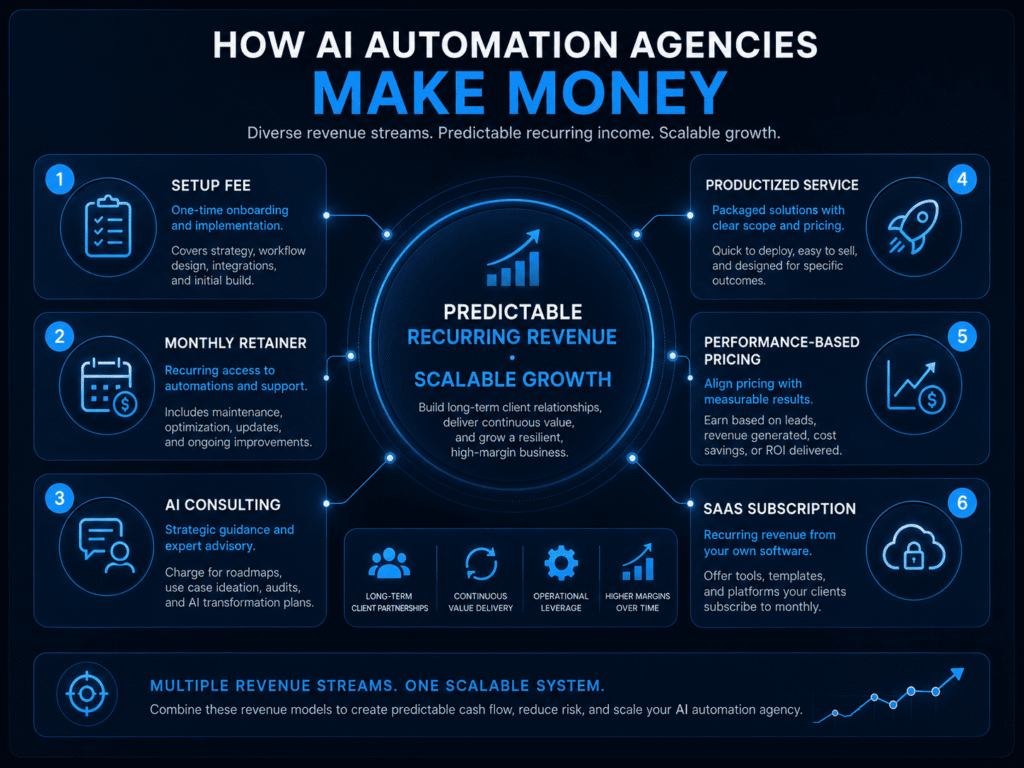
The AI agency revenue model can include several income streams. The best agencies usually combine upfront project fees with recurring revenue.
| Revenue Model | How It Works | Best For |
| Setup Fee | One-time payment to build automation systems | New automation projects |
| Monthly Retainer | Ongoing support, monitoring, and optimization | Predictable recurring revenue |
| Consulting Fee | Strategy, workflow audit, and automation roadmap | Clients unsure where to start |
| Productized Service | Fixed-scope automation package | Scaling repeatable offers |
| Performance-Based Pricing | Payment linked to results | Advanced agencies with strong tracking |
| SaaS Subscription | Monthly access to a repeatable automation tool | Long-term scalable model |
A strong AI automation agency business model does not depend only on one-time projects. Monthly retainers are important because they create stable income and allow the agency to keep improving client systems.
Best Niches for an AI Automation Agency
Choosing a niche makes the agency easier to position. A general agency saying “we offer AI automation” may sound too broad. A focused agency can explain the exact problem it solves.
| Niche | Automation Opportunities |
| Real Estate | Lead follow-up, property inquiries, CRM updates |
| Medical Clinics | Appointment reminders, patient FAQs, intake forms |
| eCommerce | Customer support, order updates, abandoned cart workflows |
| Digital Agencies | Reporting dashboards, onboarding, client communication |
| Law Firms | Intake forms, document workflows, consultation booking |
| Construction Companies | Quote requests, project updates, client notifications |
| Local Services | Call tracking, review requests, lead routing |
The best niche is one where businesses have repeated processes, valuable leads, and a need for faster customer response.
Real-World Examples of AI Automation Value
Large companies are already showing how AI automation can improve customer service, HR operations, internal support, and business efficiency. For example, AI customer support assistants can help companies handle a high volume of repeated questions, reduce waiting time, and support human teams by taking care of common requests.
Internal AI assistants are also being used to support HR, employee services, ticket handling, and knowledge management. These systems help teams find answers faster, reduce repetitive support tickets, and improve the employee experience.
These examples are enterprise-level, but the same principle applies to smaller businesses. A real estate agency can automate lead follow-ups. A clinic can automate appointment reminders. A digital agency can automate reports. An eCommerce store can automate common support questions.
The size of the business may change, but the value is the same: less manual work and faster operations.
Pricing Models for an AI Automation Agency
Pricing should be based on the value of the workflow, the complexity of integrations, the tools involved, and the level of support required.
| Package | Suitable For | What It Can Include |
| Starter Automation | Small businesses | One simple workflow, basic chatbot, lead form integration |
| Growth Automation | Growing teams | CRM automation, email follow-ups, appointment workflows |
| Advanced Automation | Larger businesses | Multi-step workflows, AI agents, dashboards, support |
| Custom Automation | Complex operations | API integrations, data governance, custom reporting |
New agencies often make the mistake of charging only by time. A better pricing strategy is to focus on the value created. If automation saves 40 hours per month or helps recover missed leads, the agency should price according to business impact.
How to Build an AI Automation Agency Business Model
1. Choose a Specific Market
The first step is choosing a target audience. An agency can focus on real estate, healthcare, eCommerce, local businesses, law firms, construction companies, or marketing agencies.
A clear niche helps with messaging, sales, and delivery.
2. Identify Workflow Problems
The agency should look for tasks that are repeated often, take too much time, or cause missed revenue. These are the best automation opportunities.
Examples include slow lead response, manual reporting, repeated customer questions, and messy CRM updates.
3. Build a Clear Offer
Instead of selling “AI automation services,” the agency should create a clear offer.
Examples:
- AI lead follow-up system for real estate agencies
- Automated reporting system for digital marketing agencies
- AI appointment booking workflow for clinics
- AI customer support system for eCommerce stores
Clear offers are easier to understand and easier to sell.
4. Create Repeatable Systems
To scale, the agency needs templates, SOPs, onboarding forms, workflow maps, testing checklists, and reporting formats.
This helps the agency deliver faster and maintain quality.
5. Add Ongoing Support
Automation requires maintenance. APIs change, tools update, workflows break, and client needs grow. Monthly support helps the agency build long-term relationships and recurring revenue.
How to Measure ROI in AI Automation
A professional AI automation agency should measure results before and after implementation. This builds trust and helps clients understand the value.
Important ROI metrics include:
- Hours saved per month
- Faster response time
- More booked appointments
- Lower support workload
- Fewer missed leads
- Reduced manual errors
- Better reporting accuracy
- Higher customer satisfaction
A simple ROI formula is:
Automation ROI = Value of time saved + additional revenue generated – automation cost
For example, if a business saves 30 hours per month and each hour is worth $20, that equals $600 in time savings. If the same automation helps generate $1,000 in extra booked calls, the total value becomes $1,600 before subtracting automation cost.
Data Privacy and AI Governance
AI automation agencies often connect with CRMs, emails, customer records, internal documents, calendars, payment tools, and analytics systems. This means data privacy and governance are important.
A reliable agency should use:
- Role-based access
- Secure API connections
- Limited permissions
- Human review for sensitive tasks
- Clear approval workflows
- Data minimization
- Audit logs where possible
- Backup and error-handling processes
This is especially important for industries like healthcare, finance, legal services, and enterprise operations.
Common Mistakes New AI Automation Agencies Make
Many new agencies fail because they focus too much on tools and not enough on business problems.
Common mistakes include:
- Selling generic AI services without a clear offer
- Choosing too many niches at once
- Building complex systems clients cannot manage.
- Ignoring training and documentation
- Charging only one-time fees
- Not measuring ROI
- Overpromising what AI can do
- Ignoring data privacy
- Depending on one tool
- Failing to create monthly support plans
The strongest agencies keep things practical. They explain AI in simple language and connect every solution to a real business outcome.
What Businesses Should Look for in an AI Automation Agency
A business should not hire an AI automation agency only because it knows popular tools. The better question is whether the agency understands business workflows.
A good agency should explain:
- What process will be automated
- What tools will be connected
- What data is needed
- How the workflow will be tested
- What happens if something fails
- How the team will be trained
- How results will be measured
- How data will be protected
Technical knowledge matters, but business understanding matters more.
Future of the AI Automation Agency Business Model
The future of the AI automation agency business model will move beyond simple automations. Businesses will want smarter systems that can understand context, support decisions, trigger actions, and improve operations across departments.
AI tools will keep evolving, but businesses will always need smoother workflows, faster execution, and more intelligent connected systems.
Winning agencies will blend AI expertise, business strategy, smart workflow design, strong data governance, and ROI-focused results they can clearly prove.
Building an AI Automation Agency That Lasts
The AI automation agency business model is not about chasing AI trends. It is about helping businesses solve real operational problems with smarter systems. Agencies that succeed will choose a clear niche, create repeatable offers, build reliable workflows, track ROI, and provide ongoing support. Businesses will continue to need help with lead management, reporting, customer support, internal operations, and workflow optimization.
Ready to build smarter workflows and reduce repetitive business tasks? CamzioTech helps businesses use AI automation, CRM workflows, chatbots, and reporting systems to improve daily operations and create measurable results.
FAQ’s
What is an AI automation agency business model?
An AI automation agency business model is a service model where an agency helps businesses automate workflows using AI tools, CRM automation, chatbots, AI agents, and integrations.
Is an AI automation agency profitable?
Yes, it can be profitable when the agency focuses on repeatable offers, clear niches, monthly retainers, and measurable business outcomes.
Who needs AI automation services?
AI automation services are useful for real estate agencies, clinics, eCommerce stores, digital agencies, law firms, construction companies, local service businesses, and companies with repeated manual tasks.
How can someone start an AI automation agency?
To start, choose a niche, identify common workflow problems, create a clear service offer, build sample automations, document the delivery process, and sell based on business value.
Can an AI automation agency work with small businesses?
Yes, an AI automation agency can work with small businesses if the solution is practical and affordable. Small businesses usually do not need complex enterprise systems.