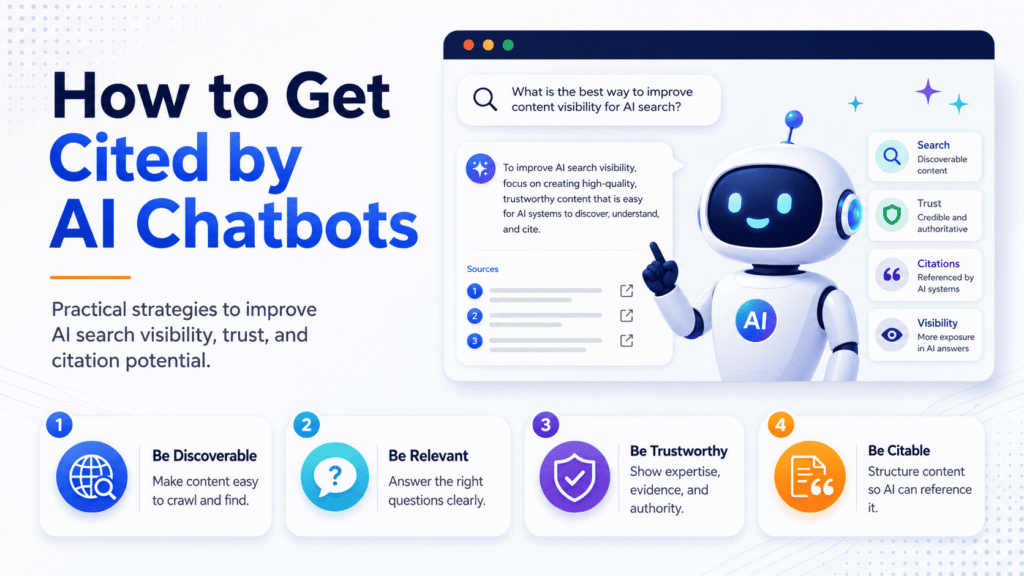
Understanding how to get cited by AI chatbots requires more than adding keywords or publishing longer articles. AI systems are more likely to reference pages that are accessible, directly relevant to the question, easy to interpret, supported by evidence, and associated with a trustworthy author or brand.
The strongest approach combines technical discoverability, passage-level optimization, semantic topic coverage, original information, and visible expertise. No method can guarantee a citation, but these elements make a page more suitable for retrieval and attribution in AI-generated answers.
What Makes Content Citation-Worthy?
AI chatbots do not need to use an entire article to answer a question. They may retrieve a single definition, statistic, comparison, explanation, or set of instructions from a page.
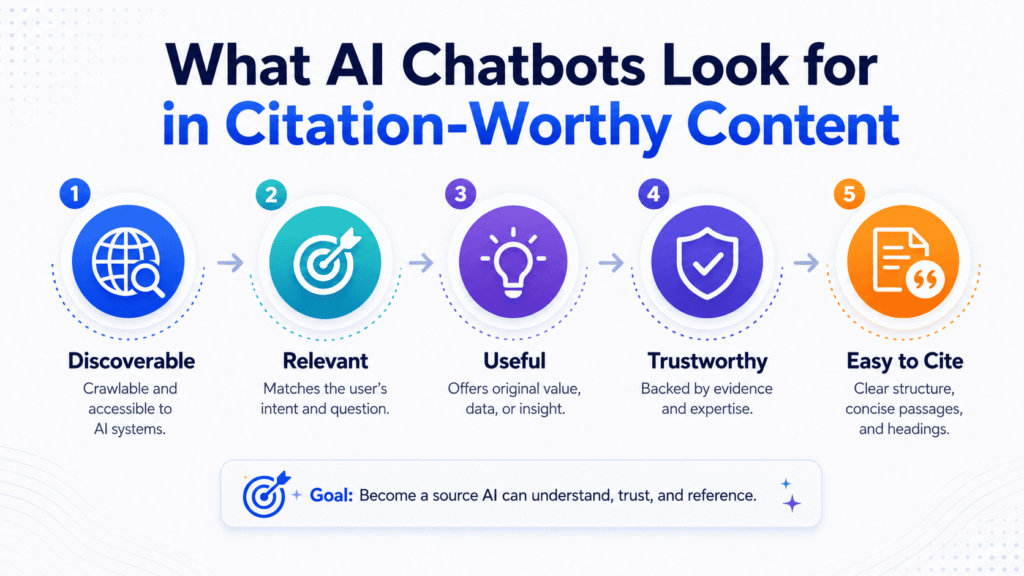
Citation-worthy content generally has five qualities:
- It answers a specific question clearly.
- It provides information that can be verified.
- It adds context, evidence, or original insight.
- It is structured into understandable sections.
- It comes from a source with relevant topical authority.
A page becomes less useful when the answer is hidden beneath a long introduction, repeated across several sections, or mixed with unrelated information.
How AI Chatbots Select Sources
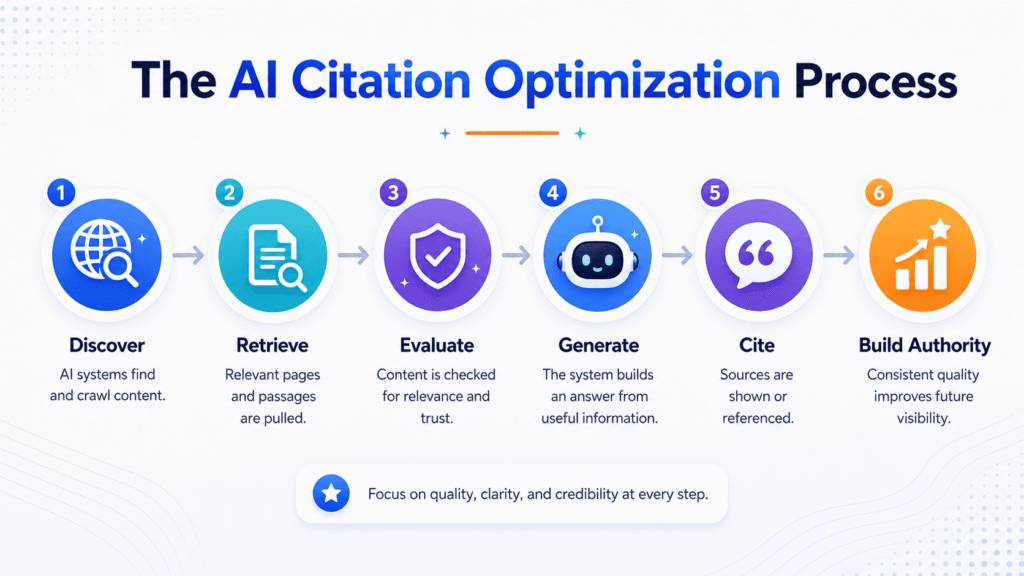
Search-connected AI systems commonly follow a process involving discovery, retrieval, evaluation, and response generation.
A simplified citation process may look like this:
- The system interprets the user’s question.
- It searches an index or retrieves relevant webpages.
- It identifies passages closely related to the question.
- It compares information across available sources.
- It generates an answer using selected material.
- It may attach citations to the supporting sources.
This means AI citation optimization should focus on both the page and the individual passages inside it. A website may have authority, but an unclear paragraph can still be overlooked. Similarly, a well-written passage may struggle if the page is blocked from crawling or lacks credibility.
How to Get Cited by AI Chatbots
1. Ensure the Page Can Be Discovered and Indexed
A page must first be accessible before an AI system can retrieve it.
Important citation-focused pages should:
- Return a successful status code
- Avoid an accidental
noindextag - Remain unblocked in
robots.txt - Use the correct canonical URL
- Appear in the XML sitemap
- Be linked from relevant pages on the website
- Display important content in crawlable HTML
A technically inaccessible article cannot earn citations regardless of its quality.
Website owners should also review whether relevant search and AI crawlers are blocked. Blocking a crawler may prevent the page from appearing in the platform’s search-connected answers.
2. Answer the Target Question Immediately
The main answer should appear near the beginning of the article and at the start of the relevant section.
For example, a page targeting how to get cited by AI chatbots should immediately explain that citations depend on discoverability, relevance, evidence, clear formatting, and source authority.
An effective opening answer may follow this pattern:
A website improves its chances of being cited by AI chatbots by publishing crawlable, well-structured content that directly answers user questions, demonstrates first-hand expertise, and supports important claims with verifiable evidence.
This approach gives readers a useful answer without forcing them to read the entire article. It also creates a clear passage that can be understood independently.
3. Create Retrieval-Friendly Passages
Each major section should focus on one clear question or idea.
A strong citation-ready passage includes:
- A descriptive heading
- A direct first sentence
- A brief explanation
- Supporting evidence or an example
- Any necessary limitation
Consider the following comparison:
Generic statement:
“High-quality content is important for getting better results from AI.”
Citation-ready statement:
“Original research can improve AI citation potential because it gives a chatbot a unique fact or finding that cannot be attributed equally to hundreds of similar articles.”
The second statement identifies the content type, explains the benefit, and provides a reason. It is more precise and easier to reference.
Long paragraphs should be divided when they contain several unrelated ideas. However, content should not be broken into one-sentence fragments simply to appear optimized.
4. Build Semantic Coverage Around the Main Topic
Semantic optimization means covering the complete meaning of a topic rather than repeatedly using one exact keyword.
For the topic how to get cited by AI chatbots, relevant supporting concepts include:
- AI citation optimization
- AI search visibility
- Generative engine optimization
- Answer engine optimization
- ChatGPT citations
- Source attribution
- Retrieval-ready content
- Topical authority
- Entity recognition
- Original research
- AI crawler access
- Passage-level relevance
- Trust signals
- AI-generated answers
These terms should appear only when they contribute useful information.
A well-optimized article should answer related questions such as:
- What makes a source citation-worthy?
- How do AI chatbots retrieve information?
- What content formats are easier to cite?
- Does schema markup help?
- How does author authority affect AI visibility?
- How can AI citation performance be measured?
This creates topical completeness without keyword stuffing.
5. Publish Information Worth Attributing
A chatbot has little reason to cite a page that repeats the same advice found across hundreds of websites.
Content becomes more valuable when it contains information that deserves attribution, such as:
- Original survey findings
- First-hand experiments
- Proprietary statistics
- Case-study results
- Product testing
- Expert observations
- Documented workflows
- Original comparison criteria
- Local market data
- A proprietary framework
For example, an SEO agency could test 100 commercial prompts across several AI chatbots and record which domains are cited most frequently. The article could then explain:
- Which prompts were tested
- When the study was conducted
- How citations were recorded
- Which industries were included
- What limitations affected the results
This type of content provides evidence that another source cannot easily reproduce.
6. Demonstrate Experience and Expertise on the Page
A page should show why its information deserves trust.
Relevant E-E-A-T signals include:
- A named author
- A detailed author biography
- Relevant work experience
- Clear publication and update dates
- A transparent research method
- First-hand screenshots or observations
- Accurate source attribution
- An editorial or correction policy
- Clear business and contact information
The author biography should be specific to the topic. A general statement such as “experienced content writer” carries less authority than a biography explaining relevant SEO projects, research, testing, or professional experience.
Claims should also be written carefully. When a point is based on observation rather than confirmed platform documentation, the article should make that distinction clear.
For example:
Clear paragraph structure may make individual passages easier to retrieve, although citation selection also depends on relevance, authority, freshness, and the system used.
This wording is more trustworthy than presenting an unverified observation as a universal rule.
7. Use Content Formats That Match Citation Intent
Different questions require different page formats.
| Content format | Citation value |
|---|---|
| Definition page | Provides a concise explanation of a specific term |
| Comparison guide | Organizes differences, advantages, and limitations |
| Original study | Offers unique findings that require attribution |
| Statistics page | Presents useful data with context |
| Step-by-step tutorial | Gives a clear sequence of actions |
| Case study | Demonstrates real experience and results |
| Expert explainer | Interprets a complex subject |
| Industry framework | Provides a reusable method or model |
The format should match the query.
A user asking “What is generative engine optimization?” needs a precise definition. A user asking “How can a company improve AI visibility?” needs a process, examples, and implementation guidance.
A long article is not automatically better. The strongest page is the one that answers the complete intent without unnecessary sections.
8. Strengthen Topical Authority With Supporting Content
One article rarely establishes authority for a broad subject.
A website targeting AI search optimization may create a topic cluster containing pages such as:
- What is AI search optimization?
- SEO vs AEO vs GEO
- How ChatGPT citations work
- How to track AI brand mentions
- Best content formats for AI citations
- Does schema help AI visibility?
- How to write retrieval-friendly content
- AI citation optimization checklist
These supporting pages should link naturally to one another.
Internal links help establish relationships between topics and guide crawlers toward important pages. Anchor text should describe the destination accurately rather than using repeated phrases such as “click here.”
The central guide can then act as a hub that explains how to get cited by AI chatbots, while supporting articles provide greater depth on individual subtopics.
9. Maintain Consistent Brand and Entity Information
AI and search systems may encounter a brand across its website, author profiles, business listings, interviews, publications, and professional platforms.
Important details should remain consistent, including:
- Business name
- Author name
- Service descriptions
- Areas of expertise
- Website address
- Contact details
- Organization information
Inconsistent information can make it harder to understand whether two profiles refer to the same person or company.
External authority should be earned through relevant contributions, research, expert commentary, and genuine industry mentions. Low-quality guest posts or artificial brand mentions are unlikely to build meaningful trust.
10. Refresh Content When the Topic Changes
AI search is developing quickly. Articles containing old platform names, outdated crawler guidance, or unsupported predictions can lose credibility.
Important pages should be reviewed for:
- Outdated platform information
- Broken or removed features
- Old screenshots
- Unsupported statistics
- Changed terminology
- New citation formats
- New first-hand findings
An update date should reflect a meaningful editorial review rather than a cosmetic change.
Freshness matters most when the query depends on current information. Stable definitions may not require frequent updates, while platform-specific guidance should be reviewed more often.
Common AI Citation Optimization Mistakes
Writing Long Introductions Without Answering the Question
A lengthy introduction delays the information both users and retrieval systems need. The main answer should appear early, followed by deeper explanation.
Publishing Generic AI-Generated Articles
AI-assisted writing is not automatically low quality. The problem is publishing derivative content without first-hand information, fact-checking, editorial review, or original analysis.
Repeating the Focus Keyword Excessively
The keyword how to get cited by AI chatbots should appear naturally in prominent locations. Repeating it in every heading and paragraph reduces readability and does not create deeper relevance.
Treating Schema as a Citation Shortcut
Structured data can clarify authors, organizations, products, and article details. It cannot guarantee a chatbot citation or compensate for weak content.
Making Claims Without Evidence
Unsupported claims reduce trust. Statistics, platform rules, and technical statements should be verifiable, while observations should be presented as observations.
Covering Too Many Unrelated Topics
An article about AI citations does not need broad sections on social media marketing, general website design, or basic content creation. Every section should support the central search intent.
How to Measure AI Citation Visibility
AI citations should be monitored separately from normal keyword rankings.
A practical tracking system can record:
- The prompts being tested
- The chatbot or search platform
- Whether the brand was mentioned
- Whether a URL was cited
- Which page received the citation
- Which competitors appeared
- The date of the test
- The type of query
- Changes after content updates
Prompts should be grouped by intent, such as:
- Definitions
- Comparisons
- Recommendations
- Problem-solving queries
- Commercial questions
- Brand-specific searches
Because AI-generated responses can vary, one test should not be considered conclusive. The same prompt should be monitored across different periods and platforms.
Referral traffic can also be reviewed, but citations and traffic are not identical. A brand may gain visibility inside an AI answer even when the user does not click the source.
AI Citation Readiness Checklist
Before publication, a citation-focused article should meet the following requirements:
- The page is crawlable and indexable.
- The main question is answered in the opening section.
- The focus keyword appears naturally in important locations.
- Each heading addresses a specific subtopic.
- Important passages can be understood independently.
- Claims are accurate and appropriately qualified.
- The article contains original insight or evidence.
- The author’s relevant experience is visible.
- Supporting pages are connected through internal links.
- Entity and brand information remain consistent.
- Structured data matches the visible content.
- Outdated information has been removed.
- Every section supports the primary search intent.
Becoming a Source AI Chatbots Can Reference
Learning how to get cited by AI chatbots is ultimately about becoming a better source, not finding a technical shortcut. The most effective pages answer specific questions, provide information worth attributing, demonstrate relevant experience, and present each idea in a clear, verifiable format.
A website that combines crawlability, semantic depth, original evidence, strong authorship, and focused topical authority has a better chance of appearing in both traditional search results and AI-generated answers.
Frequently Asked Questions
Can a Small Website Get Cited by AI Chatbots?
A smaller website can earn citations when it provides a highly relevant answer, original evidence, or deeper expertise than broader competitors. Domain size alone does not determine whether a passage is useful.
Does Content Need to Rank First on Google to Receive an AI Citation?
A top organic position is not a universal requirement. However, strong indexation, relevance, authority, and search visibility can improve the likelihood that a page is discovered and retrieved.
Does Schema Markup Guarantee AI Citations?
No. Schema markup may help systems interpret page entities and content types, but citation selection still depends on content relevance, quality, evidence, and source authority.
Can AI-Written Content Be Cited?
AI-assisted content can be cited when it is accurate, useful, well edited, and supported by genuine expertise. Generic content produced at scale without original value is less likely to become a preferred source.
How Long Does It Take to Get Cited by an AI Chatbot?
There is no fixed period. Citation visibility depends on discovery, indexing, topic competition, content quality, authority, and the retrieval process used by each platform.