
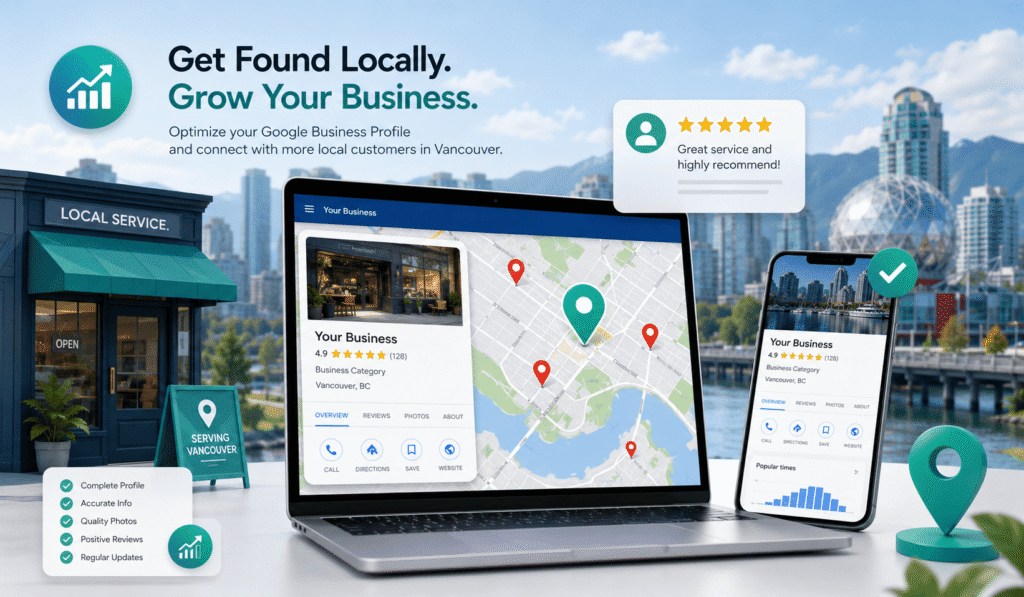
For a business in Vancouver, being easy to find online can make the difference between receiving a qualified inquiry and losing that customer to a competitor. People searching for a dentist, renovation company, café, real estate professional, or marketing service often begin with Google and choose from the businesses that appear trustworthy, relevant, and nearby.
That is why SEO tips Vancouver businesses can actually use should focus on more than rankings. A strong local SEO strategy helps a business explain what it offers, show where it operates, build trust with local customers, and turn search visibility into calls, bookings, or form submissions.
This guide explains practical ways Vancouver businesses can improve local visibility without relying on keyword stuffing or generic content.
What Helps a Vancouver Business Appear in Local Search?
Google explains local visibility through three broad ideas: relevance, distance, and prominence. Relevance is how closely a business matches a search. Distance relates to how close it is to the person searching. Prominence reflects how established and trustworthy the business appears online.
A business cannot control every part of local search, especially a customer’s location. It can, however, improve how clearly its services are presented, how complete its business information is, how customers review it, and how useful its website content becomes.
That is the foundation of effective local SEO in Vancouver.
1. Start With the Searches Local Customers Actually Use
A Vancouver SEO strategy should begin with customer intent, not with a long list of repeated keywords. A customer is more likely to search for a specific solution, such as “emergency plumber Vancouver,” “family dentist in Kitsilano,” or “commercial cleaning company Vancouver,” than to search using broad industry language.
Each important website page should target one clear need. A service page can focus on a primary service in Vancouver, while supporting blog articles can answer common customer questions about prices, timelines, comparisons, or maintenance.
Useful keyword patterns often include:
- Service + Vancouver
- Service + neighborhood, where the business genuinely operates
- Service + cost, process, emergency, near me, or best option
- Problem + local solution
A business should only mention areas it actually serves. Creating dozens of nearly identical location pages without meaningful information does not build trust with readers.
2. Keep the Google Business Profile Complete and Current
For local businesses, the Google Business Profile is often one of the first things a prospective customer sees. It can display business hours, services, photographs, phone details, reviews, and map information before a customer even visits the website.
Google’s own Business Profile guidance recommends providing complete and accurate information, verifying the profile, keeping hours up to date, adding photos, and responding to reviews.
For a Vancouver business, this means the profile should reflect real operations. The correct category should be selected, services should be listed accurately, seasonal hours should be updated, and images should show genuine work, products, premises or staff where appropriate.
A service-area business should also follow Google’s rules carefully. A company that does not serve customers at its address should not use a false storefront simply to appear in another area. Accurate information supports both trust and long-term visibility.
3. Create Service Pages That Are More Helpful Than Competitor Pages
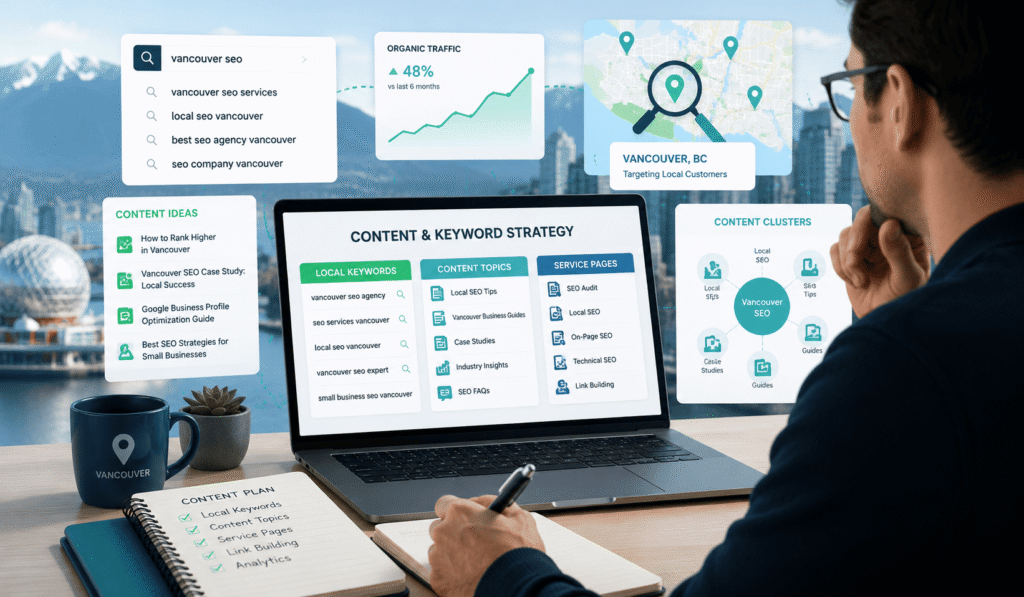
Many businesses make the mistake of relying on one homepage to rank for every service. A better approach is to create a focused page for each major offering, provided that each page contains genuinely useful information.
For example, a Vancouver landscaping company may need separate pages for residential landscaping, commercial landscaping, garden maintenance, and landscape design. A law firm may need clear pages for each legal service rather than one page filled with general claims.
A useful local service page should answer questions such as:
- What service is provided?
- Who is the service suitable for?
- What areas are served?
- What does the process involve?
- What common problems does the service solve?
- How can a customer request help?
The page should sound like it was written for real customers in Vancouver, not like it was generated by replacing one city name with another.
4. Publish Local Content That Solves Real Problems
Blog content should support customer decisions, not merely create another place to insert keywords. Helpful content can attract search visitors earlier in their decision process and guide them toward the relevant service page.
A Vancouver business can create content around questions customers genuinely ask. A property maintenance company might publish a guide about preparing a Vancouver property for wet-season maintenance. A restaurant marketing agency might discuss local search visibility for cafés in busy neighborhoods. A home service provider might answer pricing or scheduling questions relevant to customers in the city.
Strong local content usually includes practical steps, realistic examples, and a clear next action. It also links naturally to a relevant service page rather than forcing a sales message into every paragraph.
This is where many generic SEO articles fall short: they explain that content matters, but they do not show how local knowledge makes that content more valuable.
5. Improve Mobile Experience and Page Performance
Local searches often occur when someone needs a service. A slow page, confusing navigation, or a difficult contact form can cause a prospective customer to leave before making contact.
A Vancouver business website should make important actions easy on a phone. Phone numbers should be clickable, contact buttons should be visible, forms should be short, and service information should be easy to read without zooming or searching through large blocks of text.
Page performance also matters for usability. Large images should be compressed, unnecessary scripts should be reduced, and pages should load smoothly on mobile connections. Google PageSpeed Insights helps identify performance issues, but a business should also test the experience like a customer: opening the site on a mobile device and attempting to call, book, or submit an inquiry.
The goal is not simply a technical score. The goal is to make it easy for a visitor to become a customer.
6. Build Trust Through Reviews, Local Proof, and Accurate Information
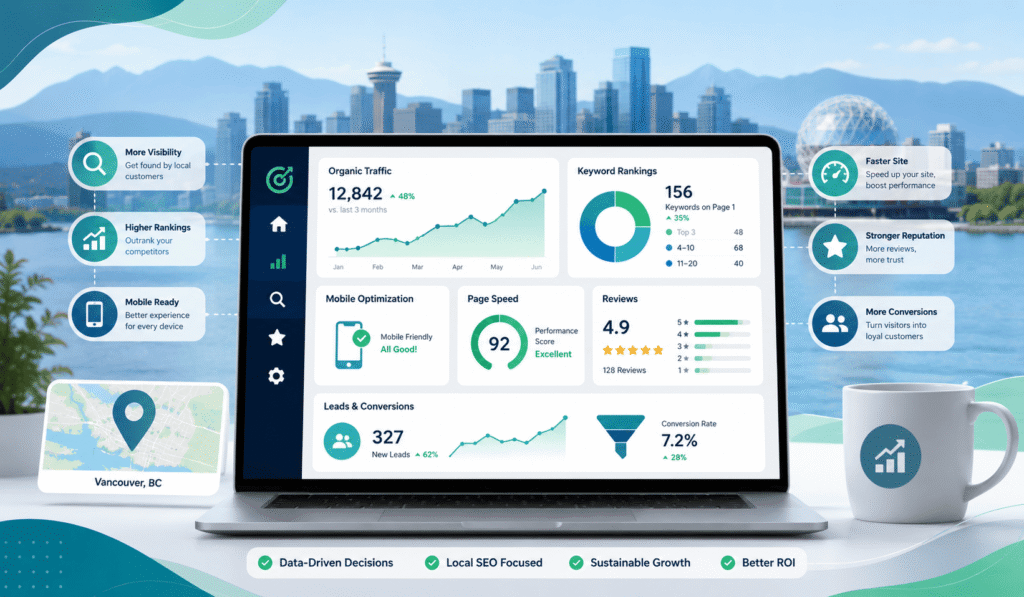
Customers do not choose businesses from search results based on rankings alone. They also look for evidence that a company is real, dependable, and experienced.
Reviews are one of the most obvious trust signals for local businesses. A company should ask genuine customers for honest feedback at appropriate moments, such as after a completed service or successful purchase. Responses should be professional and helpful, including when feedback is critical.
The website can further strengthen trust by including real project examples, service area details, team information, business contact details, and testimonials obtained with permission. Local partnerships, association memberships, or community involvement can also bolster credibility when genuine.
A business should avoid inventing case studies, exaggerating outcomes or claiming to be the “best” without evidence. Local SEO works best when online visibility is supported by real-world proof.
7. Make On-Page SEO Clear and Natural
Good on-page SEO helps readers and search engines understand a page quickly. It does not require repeating the same keyword in every sentence.
A blog targeting seo tips vancouver should use a clear page title, one descriptive H1, organised H2 headings and natural variations such as “SEO tips for Vancouver businesses” and “local SEO in Vancouver.” The introduction should establish the topic early, while the conclusion should connect the advice to a useful next step.
Other important on-page elements include:
- A descriptive meta title and meta description
- Useful internal links to related service and blog pages
- Image alt text that describes images accurately
- Short paragraphs that are easy to scan
- A clean URL that reflects the article topic
For blog articles, Article or BlogPosting structured data can help Google understand the title, image, author, and dates associated with the content. Structured data should describe visible, accurate information and should never be used to create misleading claims.
8. Earn Relevant Local Links Instead of Chasing Random Backlinks
Links can help search engines discover pages and understand their relevance, but link quality matters more than collecting unrelated directory listings.
A Vancouver business may earn meaningful mentions through local business associations, supplier relationships, community partnerships, local media coverage, event participation, or useful content that other organizations choose to reference.
For example, a professional guide answering a common local question may be more link-worthy than a thin promotional article. A business that sponsors a legitimate local initiative or contributes expert commentary to a relevant publication may also earn useful exposure.
Spammy links, paid link schemes, and unrelated websites create risk rather than authority. A credible Vancouver SEO strategy should be built around relevance and reputation.
A Simple Local SEO Checklist for Vancouver Businesses
A Vancouver business reviewing its online visibility should confirm that:
- Its Google Business Profile information is accurate and up to date.
- Its main services have clear, useful website pages.
- Its title tags and headings reflect real customer searches.
- Its website is easy to use on a phone.
- Its reviews, contact information, and local proof build confidence.
- Its blog content links to relevant services.
- Its inquiries and conversions are being measured.
These steps create a stronger foundation than publishing generic articles filled with repeated city keywords.
Make SEO Work for Your Vancouver Business
Effective SEO tips for Vancouver businesses should help real companies become clearer, more useful, and more trustworthy online. A complete business profile, helpful local content, focused service pages, genuine reviews, relevant links, and accurate tracking can all contribute to stronger local visibility.
For businesses competing in Vancouver, SEO is not about forcing a location keyword onto every page. It is about creating a website and online presence that properly represents the business, answers customer questions, and makes the next step easy.
A business that needs support improving its local visibility can request a professional SEO review focused on website structure, local search opportunities, Google Business Profile improvements, and inquiry tracking.
Frequently Asked Question’s
How long does local SEO take to show results?
There is no fixed timeline. Results depend on competition, website condition, business prominence, existing reviews, content quality, and the consistency of improvements. Some profile or website changes may gradually improve visibility, while competitive service terms often require longer-term work.
Does a business need a Vancouver address to target Vancouver customers?
A business should only represent locations and service areas accurately. A company serving customers at a real Vancouver location may show that address where appropriate. A service-area business should follow Google’s rules and avoid using false addresses purely for ranking purposes.
What is the best first SEO step for a local business?
The most practical starting point is usually a review of the Google Business Profile, main service pages, contact experience, and measurement setup. These areas directly affect how easily local customers can find and contact the business.