Many businesses want more website traffic, but higher traffic numbers do not always mean better results. Sometimes, a website may experience a sudden increase in visitors due to fake referrals, bots, spam domains, or low-quality traffic sources. These numbers may look impressive in reports, but they rarely translate into real leads, sales, calls, bookings, or customer trust.
The goal of SEO is not only to increase traffic. The real goal is to attract the right visitors who are searching for useful information, comparing services, or are ready to take action. This guide explains how businesses can increase website traffic without fake referrals SEO strategies by focusing on clean data, helpful content, technical performance, search intent, and long-term trust.
A proper SEO strategy should help both users and search engines. Search engines need to understand the website, and users need to find clear, useful, and trustworthy information. That is why real SEO growth is always better than fake traffic numbers.
What Are Fake Referrals in Website Traffic?
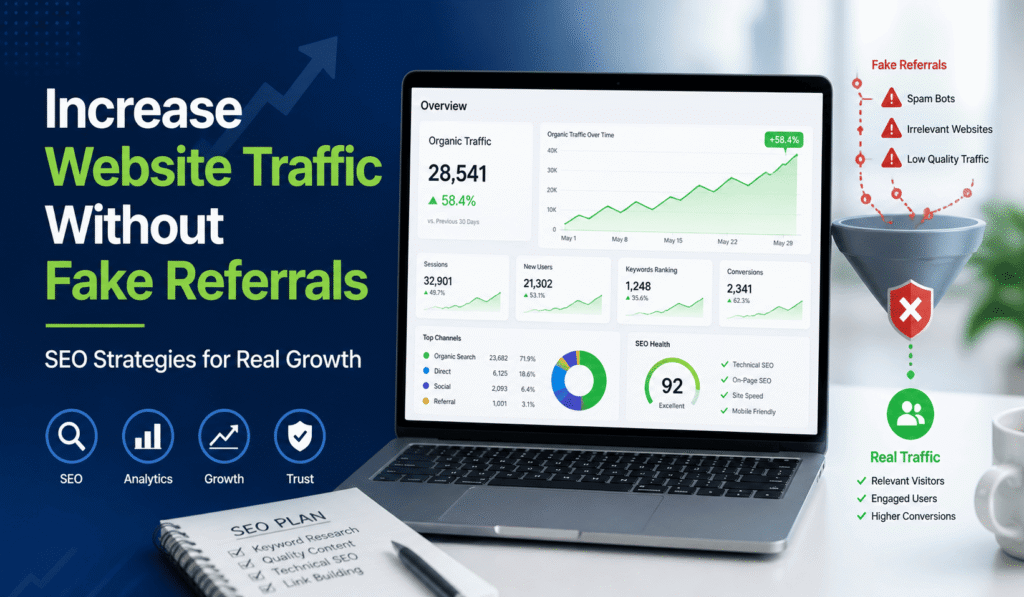
Fake referrals are visits that appear in analytics reports as referral traffic but do not come from real interested users. These visits may come from bots, spam websites, automated tools, suspicious domains, or tracking issues.
For example, a website may suddenly show traffic from unfamiliar referral domains with no connection to the business. These visitors may not read the content, click any buttons, submit forms, call the business, or take any meaningful action.
Fake referral traffic can create three major problems:
| Problem | Why It Matters |
| Misleading reports | Traffic looks higher than it really is |
| Poor decision-making | Businesses may invest in the wrong channels |
| Low-quality data | Real SEO performance becomes harder to measure |
A business should not judge SEO success only by total visitors. Real success comes from organic clicks, engaged users, leads, conversions, and trust.
Why Real SEO Traffic Is Better Than Fake Numbers
Real SEO traffic comes from people who search for a topic, find a useful page, and visit the website because it matches their needs. This type of traffic is more valuable because it is based on search intent.
For example, a visitor searching for how to increase website traffic organically is more valuable than a fake referral visit from an unknown spam domain. The first visitor may read the content, explore services, submit a form, or become a customer. The second visit only increases the number of analytics.
Real traffic helps businesses understand:
- Which pages do users find useful
- Which keywords bring the right audience
- Which services are people interested in
- Which pages generate leads
- Which SEO actions are working
Fake traffic creates confusion. Real organic traffic creates direction.
How to Identify Fake Referral Traffic
Before improving SEO, businesses should check whether their analytics data is clean. If reports are full of fake referral traffic, it becomes difficult to understand what is actually working.
Common signs of fake referral traffic include:
| Sign | What It Means |
| Sudden traffic spikes | Traffic increases without any real campaign or ranking improvement |
| Unknown referral domains | Visits come from websites unrelated to the business |
| Very low engagement | Visitors leave quickly and do not interact |
| No conversions | Traffic does not generate calls, forms, sales, or inquiries |
| Strange locations | Traffic comes from regions outside the target market |
| Repeated spam sources | Same suspicious domains appear again and again |
A proper SEO traffic audit should compare referral traffic, organic traffic, top landing pages, engagement rate, and conversions. This helps separate useful traffic from fake or low-quality visits.
How to Reduce Fake Referrals in Analytics
Reducing fake referrals starts with proper tracking and regular monitoring. Businesses should not ignore suspicious traffic sources because they can affect reporting accuracy.
A basic cleanup process includes:
- Review referral traffic sources regularly
- Identify suspicious or irrelevant domains
- Check engagement rate and conversion behavior
- Add unwanted referral domains in analytics settings where needed
- Monitor reports after changes
- Compare traffic quality before and after cleanup
This does not replace SEO work, but it improves reporting accuracy. Clean analytics help businesses understand which pages, keywords, and channels are actually bringing real visitors.
SEO Strategies to Increase Real Website Traffic
To increase website traffic without fake referrals, businesses should focus on organic SEO methods that bring qualified users. These strategies are safer, more sustainable, and better for long-term growth.
Create Content Based on Search Intent
Search intent refers to the reason a user is searching. A person searching for what are fake referrals needs information. A person searching for SEO services to increase website traffic may be closer to hiring an expert.
Content should match the intent behind each keyword.
| Search Intent | Example Keyword | Best Content Type |
| Informational | What are fake referrals | Blog guide |
| Commercial | Best SEO strategies for website traffic | Comparison or service guide |
| Transactional | Hire SEO expert for website traffic | Service page |
| Local | SEO agency near me | Local landing page |
Instead of repeating the same keyword unnaturally, the article should use related phrases naturally. Helpful variations include organic traffic growth, referral spam, clean analytics, real website visitors, SEO traffic strategies, search visibility, quality leads, and increase organic traffic.
This makes the content more natural for readers and easier for search engines to understand.
Improve Existing Content for Faster SEO Growth
Many websites already have pages that can perform better with updates. Old blogs and service pages may need stronger headings, updated facts, better internal links, FAQs, images, and clearer calls to action.
A content refresh can include:
- Updating outdated information
- Improving the introduction
- Adding missing subtopics
- Adding FAQs
- Optimizing title tags and meta descriptions
- Adding internal links to related services
- Improving readability
- Adding tables and examples
- Removing weak or duplicate sections
This approach helps users because the content becomes easier to understand and more complete. It also helps search engines see that the page is fresh, useful, and relevant.
Strengthen On-Page SEO
On-page SEO helps both search engines and users understand the page. Each important page should have a clear structure and a natural keyword focus.
Important on-page SEO elements include:
| SEO Element | What to Improve |
| H1 heading | Use the main topic clearly |
| H2 headings | Organize the article into helpful sections |
| Meta title | Make it keyword-focused and clickable |
| Meta description | Add a clear benefit and call to action |
| Image alt text | Describe images naturally |
| Internal links | Connect related blogs and service pages |
| FAQs | Answer long-tail questions clearly |
A well-structured page is easier to read, easier to crawl, and more useful for visitors. It also keeps users engaged for longer because they can quickly find the information they need.
Fix Technical SEO Issues
Technical SEO makes sure a website can be crawled, indexed, and loaded properly. If a website is slow, broken, blocked, or poorly structured, even good content may struggle to rank.
Key technical SEO checks include:
- Mobile-friendly design
- Fast page loading speed
- Clean URL structure
- XML sitemap
- Robots.txt review
- Broken link fixes
- HTTPS security
- Canonical tags
- Schema markup
- Indexing checks in Google Search Console
Technical SEO is important because it removes ranking barriers. A business may publish excellent content, but if search engines cannot crawl or index it properly, the page may not perform well.
Build Trust With Quality Backlinks
Backlinks can support SEO when they come from relevant and trustworthy websites. However, spam backlinks, paid link schemes, and low-quality referral sources can create risk.
Better backlink strategies include:
| Strategy | Why It Helps |
| Guest posts on relevant websites | Builds authority and referral value |
| Local partnerships | Creates trusted local signals |
| Digital PR | Earns brand mentions from credible sources |
| Helpful guides | Attracts natural backlinks |
| Case studies | Shows real experience and results |
The focus should be on earning links because the content is useful, not creating links only to manipulate rankings. A few strong, relevant backlinks are better than hundreds of weak or spammy links.
Use Local SEO to Attract Qualified Visitors
For local businesses, traffic quality matters more than traffic quantity. A cleaning company, real estate agency, digital marketing agency, clinic, plant supplier, or contractor does not need random global traffic. It needs visitors from the right location who are likely to contact the business.
Local SEO can improve qualified traffic through:
- Google Business Profile optimization
- Local service pages
- City-based keywords
- Reviews and ratings
- Local citations
- Local backlinks
- NAP consistency
- Location-specific FAQs
For example, a business targeting Dubai, Abu Dhabi, Sharjah, Calgary, or any specific city should create content that speaks directly to users in those locations. This makes the content more relevant and helps attract people who are more likely to convert.
Track the Right SEO Metrics
A website should not only track total traffic. It should track traffic quality.
Important SEO metrics include:
| Metric | Why It Matters |
| Organic clicks | Shows search traffic growth |
| Impressions | Shows search visibility |
| CTR | Shows how attractive titles and descriptions are |
| Engagement rate | Shows whether users find the page useful |
| Conversions | Shows business impact |
| Top landing pages | Shows which pages attract visitors |
| Referral source quality | Helps identify spam or fake referrals |
Search Console and analytics tools should be used together. Search Console shows how users find the site in search, while analytics tools show what users do after they land on the website.
Common Mistakes to Avoid
| Mistake | Why It Hurts |
| Buying fake traffic | It increases numbers but not customers |
| Ignoring referral spam | Reports become inaccurate |
| Copying competitor content | It reduces originality and trust |
| Keyword stuffing | It creates poor user experience |
| Publishing thin content | It fails to answer user questions |
| Ignoring technical SEO | Pages may not rank properly |
| Tracking only visitors | Traffic without leads has limited value |
Avoiding these mistakes helps protect the website from poor-quality SEO practices and keeps the focus on real business growth.
30-Day SEO Action Plan
| Week | Action Plan |
| Week 1 | Audit analytics, referral sources, top pages, keywords, and conversions |
| Week 2 | Update title tags, meta descriptions, headings, old content, and internal links |
| Week 3 | Publish helpful content based on search intent and long-tail keywords |
| Week 4 | Build quality backlinks, improve technical SEO, add FAQs, and review results |
This plan helps businesses move from fake traffic numbers to real SEO growth. It also gives website owners a simple process to follow, rather than guessing what to improve next.
Start Building Real SEO Traffic That Converts
Increasing website traffic without fake referrals is not about chasing empty numbers. It is about building clean, trusted, and high-quality traffic from real users who are actively searching for products, services, or information. By improving analytics accuracy, creating helpful content, fixing technical SEO issues, and earning trustworthy backlinks, businesses can grow organic visibility in a way that leads to real inquiries, sales, and long-term results.
A website that focuses on real SEO growth becomes easier for search engines to understand and more valuable for users to trust. Start by auditing traffic sources, removing fake referral noise, and improving the pages that already have ranking potential. Over time, these small but consistent SEO actions can turn a website into a stronger source of qualified leads.
For expert help with SEO-friendly article writing, content strategy, and organic traffic growth, Camzio Tech can help you create content that attracts real visitors and turns them into leads.
FAQs
How can a website increase traffic without fake referrals?
A website can increase real traffic by using organic SEO, helpful content, clean analytics, technical SEO, quality backlinks, and search intent-based keyword targeting.
Can a website increase organic traffic without backlinks?
Yes, a website can grow some traffic without active link building, especially if it has strong content, good internal linking, technical SEO, and low-competition keywords.
Does fake referral traffic help SEO?
No. Fake referral traffic does not build trust, generate leads, improve rankings, or drive customer engagement. It usually only makes analytics reports look inflated.
How can I tell if website traffic is fake or real?
Fake traffic often has warning signs such as sudden spikes, strange referral domains, zero engagement, no conversions, unusual countries, and repeated visits from irrelevant sources.
Does fake referral traffic damage SEO rankings?
Fake referral traffic usually creates more reporting problems than direct ranking problems. However, if fake traffic is connected with spam backlinks, bot activity, or manipulative SEO tactics, it can create trust and quality issues.