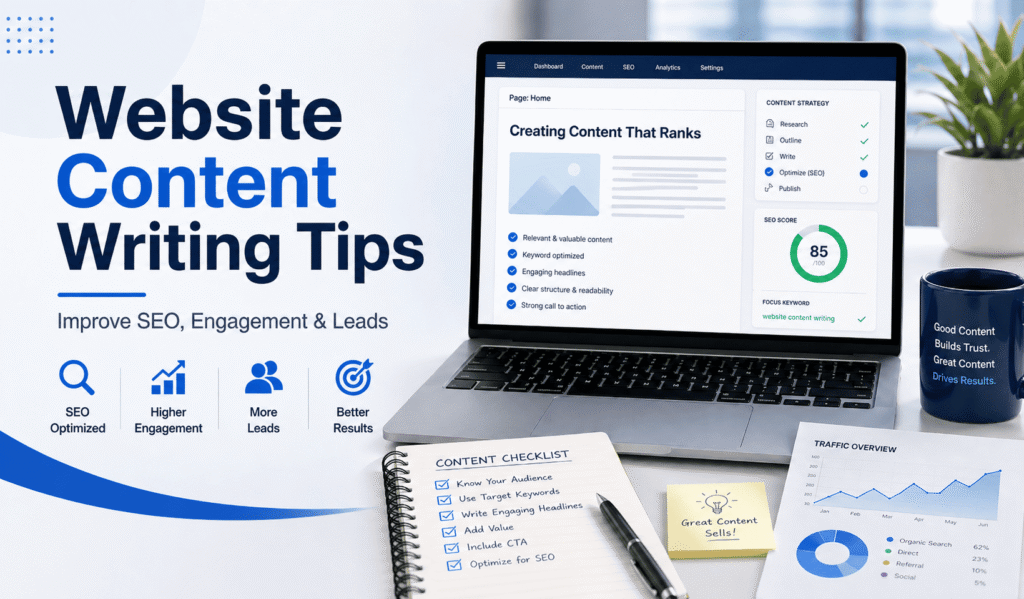
Website content is not just written to fill space on a page. It plays a direct role in how visitors understand a business, how search engines evaluate a website, and how confidently potential customers take the next step.
A website may have a modern design, fast loading speed, and attractive visuals, but if the content is unclear, generic, or difficult to read, visitors may leave without contacting the business. Strong website content helps explain value, answer customer questions, build trust, and support better search engine visibility.
That is why businesses need practical Website Content Writing Tips that focus on both users and SEO. The goal is not only to write more words, but to create useful, original, and conversion-focused content that helps visitors make informed decisions.
Expert Note:
This guide is designed for business owners, marketers, and website managers who want to improve website content for better readability, SEO performance, and lead generation. The tips below focus on practical content improvements that support both user experience and search visibility.
Why High-Quality Website Content Matters
High-quality website content helps a business explain who it is, what it offers, and why people should trust it. A professional website design may create the first impression, but the content decides whether visitors stay, read, and take action.
Good website content can help improve:
- Search engine visibility
- User experience
- Brand trust
- Lead generation
- Product or service understanding
- Conversion rates
- Customer confidence
Search engines are designed to reward helpful, reliable, and people-first content. This means businesses should avoid copied, thin, or keyword-stuffed content. Instead, every page should provide clear value to the visitor.
1. Understand the Audience Before Writing
One of the most important website content writing tips is to understand the audience before creating any content. A business should know who it is speaking to, what problems the audience has, and what information they need before taking action.
Before writing a website page or blog post, it helps to ask:
- Who is the target reader?
- What problem are they trying to solve?
- What questions do they have?
- What information would help them trust the business?
- What action should they take after reading?
For example, a cleaning company should not only say it provides cleaning services. It should explain what type of cleaning it offers, who the service is for, what problems it solves, and why customers can trust the team.
When content is written around the audience’s real needs, it becomes more helpful, natural, and persuasive.
2. Match Content With Search Intent
Search intent means the reason behind a user’s search. If the content does not match search intent, it may struggle to rank or convert visitors.
For example, someone searching for Website Content Writing Tips is likely looking for practical advice, examples, and steps to improve website content. They are not immediately looking for a sales page. That means the article should educate first, then guide readers toward the next step.
| Search Intent | What the User Wants | Best Content Type |
|---|---|---|
| Informational | To learn something | Blog posts, guides, FAQs |
| Commercial | To compare options | Service pages, comparison articles |
| Transactional | To take action | Landing pages, product pages |
| Local | To find nearby services | Local service pages, location pages |
When content matches search intent, visitors are more likely to stay longer, read more, and trust the information.
3. Keep Sentences and Paragraphs Easy to Read
Website visitors usually scan content before reading it fully. Long paragraphs, complicated words, and crowded pages can make visitors leave quickly.
A good rule is to keep most paragraphs short and focused. Each paragraph should explain one clear idea. Sentences should be simple, direct, and easy to understand.
For better readability, website content should include:
- Short paragraphs
- Clear headings
- Simple wording
- Active voice
- Bullet points
- Enough white space
- Natural flow
For example, instead of writing:
Businesses seeking to improve their digital presence should consider implementing a structured content strategy that facilitates better engagement.
A clearer version would be:
Businesses can improve their online presence with a clear content strategy that helps visitors understand, trust, and contact them.
The second version is easier to read and works better for website content.
4. Use Clear Headings and Subheadings
Headings help both readers and search engines understand the structure of a page. A strong heading tells the reader what the next section is about.
Every page should have one clear H1 heading. After that, H2 and H3 headings should divide the content into useful sections. This makes the page easier to scan and improves the reading experience.
A weak heading would be:
“Our Services”
A better heading would be:
“Professional Website Content Writing Services for Growing Businesses”
The better heading gives more context, includes a natural keyword, and explains the value of the section.
Good headings should be specific, helpful, and relevant. They should not be overloaded with keywords.
5. Write Original Content That Adds Real Value
Originality is one of the most important parts of effective website content writing. Visitors do not want to read the same generic information they have already seen on other websites.
Original content does not mean the topic must be completely new. It means the content should provide fresh value, useful explanations, and business-specific details.
A business can make content more original by adding:
- Real service details
- Practical examples
- Step-by-step explanations
- Common mistakes
- Industry knowledge
- Customer-focused answers
- Process details
- Trust signals
For example, many websites say:
We provide high-quality services at affordable prices.
That line is too generic. A stronger version would be:
The team follows a structured process that includes project review, content planning, SEO optimization, editing, and final quality checks before publishing.
The second version feels more trustworthy because it explains what quality means in practice.
6. Optimize Website Content for SEO Naturally
SEO content writing helps a website appear for relevant searches, but optimization should never make the content sound robotic. The primary keyword should be used naturally in important areas such as the title, introduction, headings, and conclusion.
For this topic, useful keyword variations include:
- Website content writing
- SEO content writing tips
- How to write website content
- Website copywriting tips
- High-quality website content
- User-friendly website content
- Content optimization tips
Important SEO areas include:
| SEO Area | Recommended Use |
|---|---|
| SEO Title | Website Content Writing Tips to Attract and Convert Visitors |
| URL Slug | website-content-writing-tips |
| H1 | Website Content Writing Tips to Attract, Engage, and Convert Visitors |
| Introduction | Use the main keyword naturally in the first 100 words |
| Headings | Use related keywords where they fit naturally |
| Image Alt Text | Describe images clearly with relevant keywords |
| Internal Links | Link to related service or blog pages |
| Conclusion | Use the main keyword once naturally |
Keyword stuffing should be avoided. A better strategy is to cover the topic completely and use related terms naturally throughout the article.
7. Add Proof, Trust Signals, and Experience
Trust is a major part of website content. Visitors want to know whether a business is reliable before they contact it, book a service, or make a purchase.
This is where EEAT becomes important: experience, expertise, authoritativeness, and trustworthiness.
A website can build trust by including:
- Years of experience
- Client testimonials
- Case studies
- Clear service details
- Team information
- Certifications
- Real project examples
- Transparent pricing guidance
- Updated and accurate information
- Clear contact details
For example, a service page that only says Best digital marketing agency is not very convincing. A stronger version would explain what the agency does, who it helps, what results it focuses on, and how the process works.
Trustworthy content does not depend on empty claims. It supports claims with useful details.
8. Use Visuals to Make Content Easier to Understand
Images, videos, charts, icons, and infographics can make website content more engaging. Visuals help visitors understand information faster and make the page easier to scan.
Useful visuals may include:
- Service process graphics
- Product images
- Screenshots
- Before-and-after examples
- Comparison charts
- Infographics
- Short explainer videos
- Team photos
However, visuals should be relevant. Random stock photos do not add much value. Every image should support the message of the page.
For SEO, images should also have compressed file sizes, descriptive file names, and clear alt text.
Example image alt text:
Website content writing tips for better SEO and user experience
9. Add Clear Calls to Action
Website content should guide visitors toward the next step. A page without a clear call to action may lose potential leads.
A call to action can encourage visitors to:
- Request a quote
- Book a consultation
- Contact the team
- View services
- Download a guide
- Subscribe to updates
- Buy a product
The CTA should match the purpose of the page. A blog post may use a softer CTA, while a service page can use a more direct CTA.
For example:
Want content that explains your value clearly? Explore professional content writing services designed to improve readability, SEO, and conversions.
A strong CTA helps visitors understand what to do next without feeling pressured.
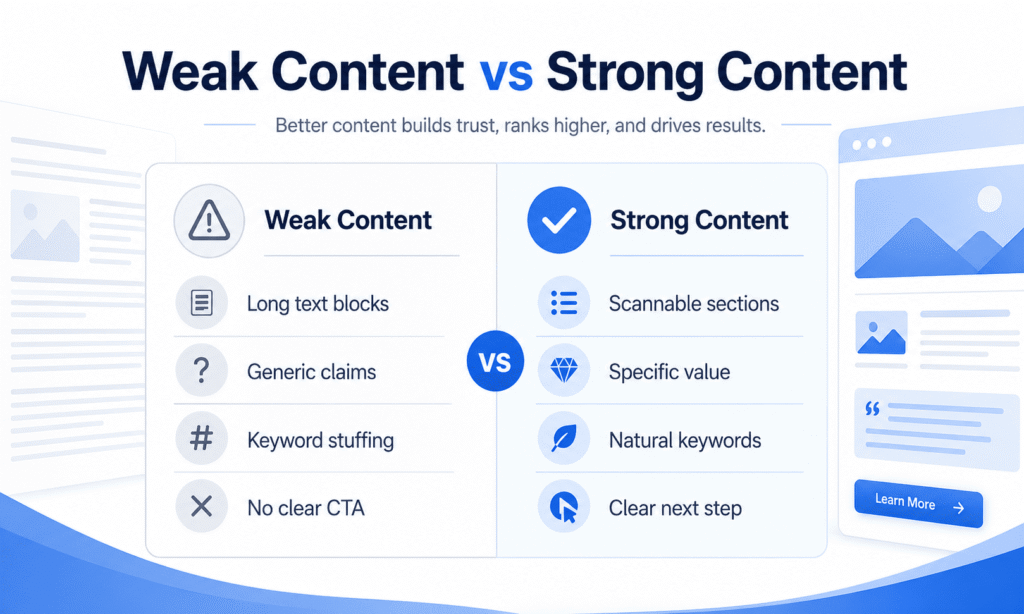
Example: Weak Website Content vs Strong Website Content
Weak content usually sounds generic and does not explain real value.
| Weak Website Content | Strong Website Content |
|---|---|
| We offer the best services | The team provides SEO-focused website content that helps businesses explain services clearly and attract qualified leads |
| Contact us today | Request a consultation to improve your website content, structure, and search visibility |
| We are experts | The content process includes research, keyword planning, writing, editing, and optimization |
| Affordable solutions for everyone | Flexible content writing solutions are available for small businesses, service pages, blogs, and landing pages |
The stronger examples explain who the service helps, what the business does, and what result the customer can expect.
Website Content Writing Checklist
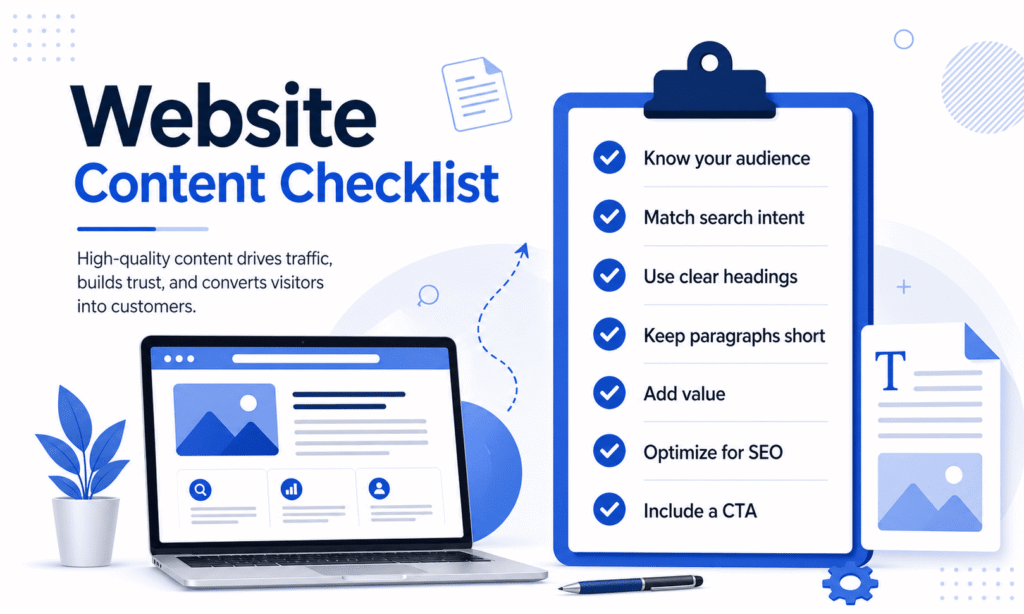
Before publishing website content, review the following checklist:
- Is the content written for the target audience?
- Does the page match the main search intent?
- Is the primary keyword used naturally?
- Are related keywords included where they fit?
- Are headings clear and properly structured?
- Are paragraphs short and easy to scan?
- Does the content include examples or proof?
- Are images optimized with alt text?
- Are internal links added naturally?
- Is there a clear call to action?
- Has the content been proofread?
- Is the information accurate and up to date?
This checklist helps make sure the content is useful for readers and better optimized for search engines.
Common Website Content Writing Mistakes to Avoid
Many websites fail because the content is written without a clear strategy. Some common mistakes include:
- Writing only for search engines
- Copying competitor content
- Using too much jargon
- Ignoring search intent
- Writing long paragraphs
- Adding keywords unnaturally
- Not including a CTA
- Publishing without proofreading
- Not updating old content
Another common mistake is focusing only on features instead of benefits. Visitors want to know how a service or product helps them.
For example, instead of only saying fast website development, a business can explain that fast development helps launch campaigns sooner, reduce delays, and improve business visibility faster.
Build Website Content That Works for People and Search Engines
Better website content starts with clarity. When a business understands its audience, answers real questions, uses proper structure, and writes with trust in mind, the website becomes more useful for visitors and easier for search engines to understand.
The goal is not only to publish content. The goal is to publish content that helps people make decisions. By following these Website Content Writing Tips, businesses can improve readability, strengthen SEO performance, build authority, and turn more visitors into leads or customers. A strong website needs more than attractive design. It needs content that explains, guides, builds trust, and converts.
Want website content that attracts visitors, builds trust, and supports better rankings? Camzio Tech helps businesses create SEO-friendly website content and digital marketing strategies that turn online traffic into real leads.
FAQ’s
What are the best website content writing tips for beginners?
The best tips are to understand the audience, write in simple language, use clear headings, keep paragraphs short, add useful examples, optimize for SEO, and include a clear call to action.
How do I write SEO-friendly website content?
Start by understanding search intent. Then use relevant keywords naturally, structure the page with headings, write helpful content, add internal links, optimize images, and create a strong meta title and description.
What is the difference between website content writing and copywriting?
Website content writing focuses on educating, informing, and explaining. Copywriting focuses more on persuasion and conversions. Strong website pages often use both.
Why is original website content important for SEO?
Original content helps a website stand out, provides unique value to visitors, and gives search engines more reason to understand and rank the page.
How often should website content be updated?
Important pages and blog posts should be reviewed regularly. Updating content keeps information accurate, improves relevance, and can help recover or improve search performance.