
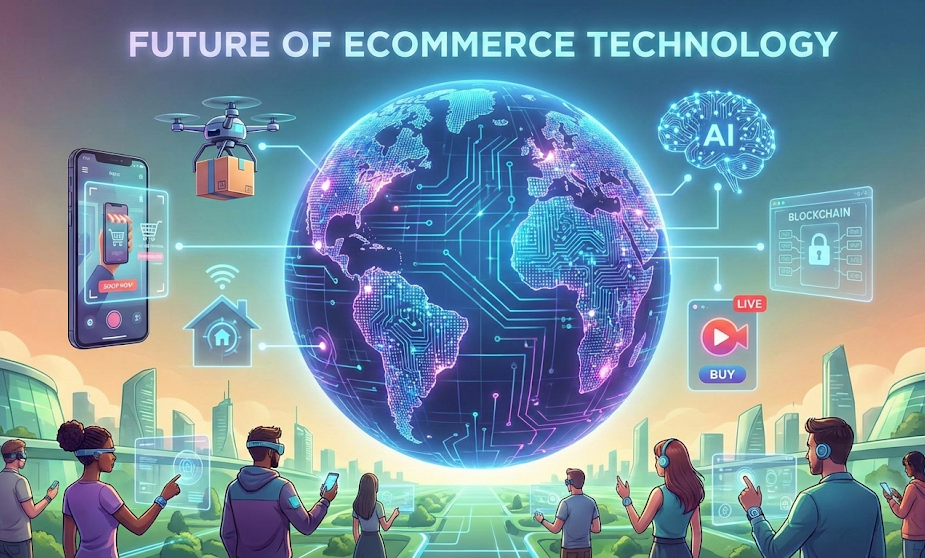
As we move through 2026, the boundaries between scrolling, socializing, and shopping have dissolved. For business leaders and merchants, the question is no longer “Do we need new tech?” but rather “How do we build an ecosystem that is faster, smarter, and more human?” This isn’t just speculation. According to recent data from Trade.gov, the global B2B ecommerce market alone is projected to reach a staggering $36 trillion by 2026. Meanwhile, consumer demand for speed and sustainability is at an all-time high. Below, we study the future of e-commerce technology through seven critical innovations that are rewriting the rules of retail.
1. The “Channel-less” Reality
For years, the industry buzzed about “omnichannel”. The idea of selling everywhere. But in 2026, we are entering the “channel-less” era.
A “channel” implies a silo: a customer shops either on your app or in your store. The future of e-commerce technology erases these lines. A single buyer’s journey might start with a voice search in the car, transition to a social media video, and finish with a physical pickup.
Why Unified Commerce Matters
The standalone online store is dying. It is being replaced by Unified Commerce Platforms, where:
- Inventory is Liquid: Customers can see real-time stock levels across all warehouses and physical stores.
- Context Travels: If a user complains to a chatbot about a delay, the in-store associate they visit an hour later already knows the issue.
Strategic Insight: If your tech stack doesn’t sync your physical and digital data in real-time, you aren’t just losing a sale; you are losing lifetime loyalty.
2. Agentic AI: The End of “People Who Bought This…”
We have moved past simple product recommendations. As we utilize Artificial Intelligence (AI), retail is exploding with 80% of retail executives expecting to fully adopt AI automation by 2027.
From Recommendation to Negotiation
The future isn’t about an algorithm suggesting you a pair of socks. It is about Agentic AI agents that act on behalf of the customer.
- For B2C: Imagine a shopper telling an AI, “Find me a red dress under $100 that will arrive by Friday plus pair it with these shoes.” The AI doesn’t just search; it filters, validates shipping times, and even negotiates bundles.
- For B2B: Generative AI is changing procurement. It can take a 500-page Request for Proposal (RFP) and instantly verify if a supplier’s catalog meets complex technical specifications.
3. Mobile Commerce: The “App-First” Economy
If your store isn’t mobile-optimized, you are invisible. Forecasts indicate that mobile devices will account for nearly 60% of global e-commerce sales in 2026.
The Rise of Progressive Web Apps (PWAs)
Native apps are expensive to build and hard to get users to download. The solution? Progressive Web Apps (PWAs). These are websites that look and feel like apps offering push notifications, offline browsing, and ultra-fast speeds without the friction of an app store download.
Why Speed Wins:
- 43% of Gen Z shoppers start their search on TikTok, Instagram, or other social apps.
- If the transition from “social feed” to “checkout” takes more than 3 seconds, you lose the sale.
4. Social Commerce & Shoppable Video
Social media is no longer only for brand awareness but now it is the point of sale. We are seeing a massive migration toward embedded commerce, where the entire transaction takes place within the social platform.
The “Discovery-to-Buy” Loop
Platforms such as TikTok and Instagram have trained users to expect instant satisfaction.
- Livestream Shopping: Popularized in Asia, this trend is now mainstream globally. An influencer demonstrates a product live, and viewers click to buy without leaving the stream.
- Creator-Led Economy: Trust has shifted from brands to people. A recommendation from a favorite creator has more influence than a million-dollar ad campaign.
Stat Check: Social commerce buyers in the US alone are projected to exceed 104 million, driven largely by younger age groups who treat social platforms as their primary search engines.
5. The B2B Digital Revolution
The biggest sleeping giant in the future of e-commerce technology is B2B. The days of faxing orders and calling sales reps are over. Today’s B2B buyer is a millennial who expects an Amazon-like experience.
The Consumerization of B2B
B2B buyers now demand digital self-service. They want to:
- View contract-specific pricing instantly.
- Reorder past shipments with one click.
- Track freight logistics in real-time.
With the B2B market outpacing B2C in sheer value ($36 trillion vs. $5.5 trillion), investing in a solid B2B portal is the single highest-ROI move a wholesaler or manufacturer can make in 2026.
6. Eco-Friendly Tech & The “Green” Checkout
Sustainability is no longer a “nice-to-have ” now it is a purchase driver. Research from Capgemini shows that 64% of customers prioritize buying from sustainable brands.
Technology That Proves Impact
Consumers are skeptical of “greenwashing.” The future of e-commerce technology involves transparency tools:
- Blockchain Tracing: Luxury and food brands are using blockchain to prove the origin of their goods. A customer can scan a QR code to see the exact farm where their coffee beans were grown.
- Carbon Calculators: Checkout pages now feature API integrations that calculate the order’s carbon footprint and offer “green shipping” options toward eco-conscious buyers.
7. Infrastructure: Headless and Composable Commerce
How do you support all these trends AI, mobile, social, and B2B at the same time? You can’t do it with a rigid, old-school platform. You need Headless Commerce.
Decoupling for Speed
Headless commerce separates the “front end” (what the customer sees) from the “back end” (your database).
- Flexibility: You can launch a new smartwatch app or a voice shopping skill without rebuilding your entire website.
- Speed: Updates that used to take weeks now take hours. This “Composable” approach lets brands plug in the best AI tool, the best search tool, and the best payment tool, rather than being stuck with a “one-size-fits-all” suite.
Conclusion:
The future of e-commerce technology is not about chasing every trend now it is about establishing a foundation that can adapt.
Whether it is the $36 trillion B2B wave or the 60% mobile dominance, the data sends a clear message: The static website is dead. The winners of 2026 will be the brands that use technology to become fluid, personal, and everywhere their customers are.
Ready to future-proof your business? Start by auditing your mobile speed and analyzing how Agentic AI can remove friction from your customer journey. The future isn’t waiting, it’s already in your customer’s pocket.